In the Studio: Michael Arcega
“It's this kind of alchemical thing that happens when you abstract a word. It c...

Suchitra Mattai is a Los Angeles-based artist of Indo-Caribbean descent and a 2025 Joan Mitchell Fellow. We interviewed her about her work and creative practice in March 2026. The following is excerpted and edited from the artists’ responses.
I am a frenetic and intuitive maker who cherishes problem solving and experimentation with materials and evolving processes. My multimedia practice embodies fiber-based installations, sculpture, mixed-media paintings, and collage. I often combine found objects, particularly textiles, that carry emotive stories.
My work creates an equitable “future space” where our collective consciousness is expanded to include new mythologies that celebrate and monumentalize the experiences of women and people of color. My ancestors’ experience and history of indentured labor in Guyana informs much of my practice.
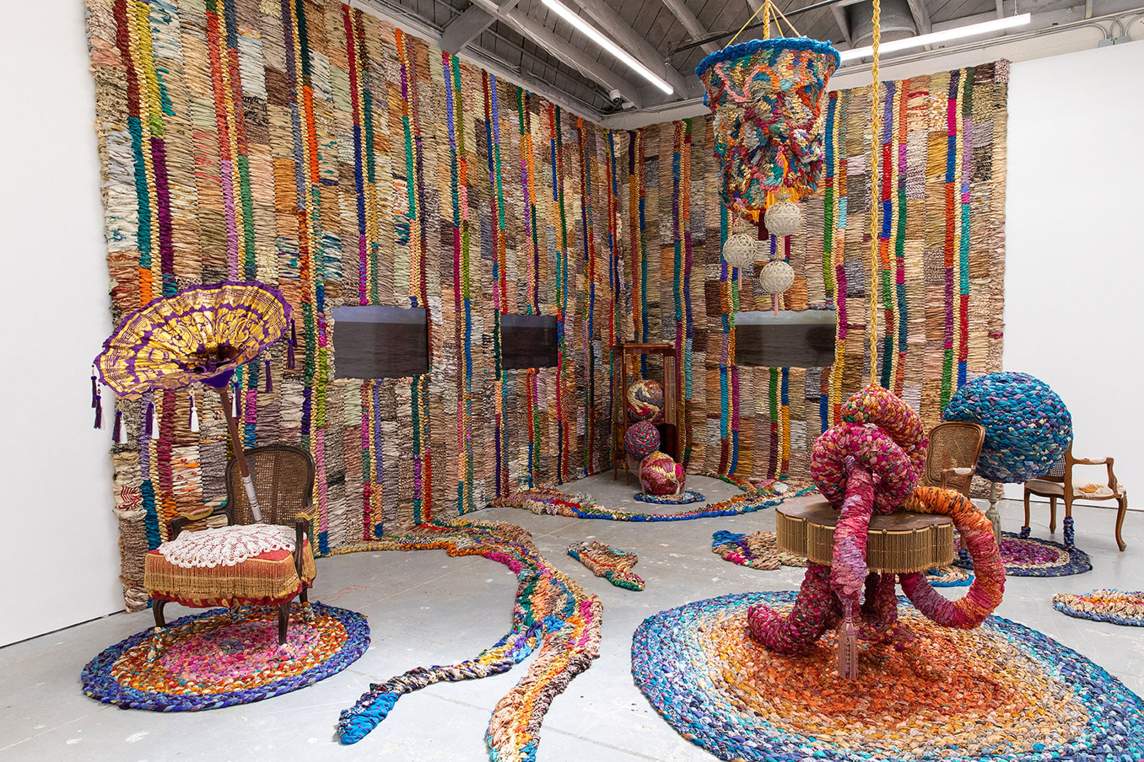
Processes such as sewing, embroidery, beading, and crochet were taught to me by my Grandmothers and Mother. I hope to honor the labor and creative spirit of women of the past by highlighting “craft-based” materials and processes.
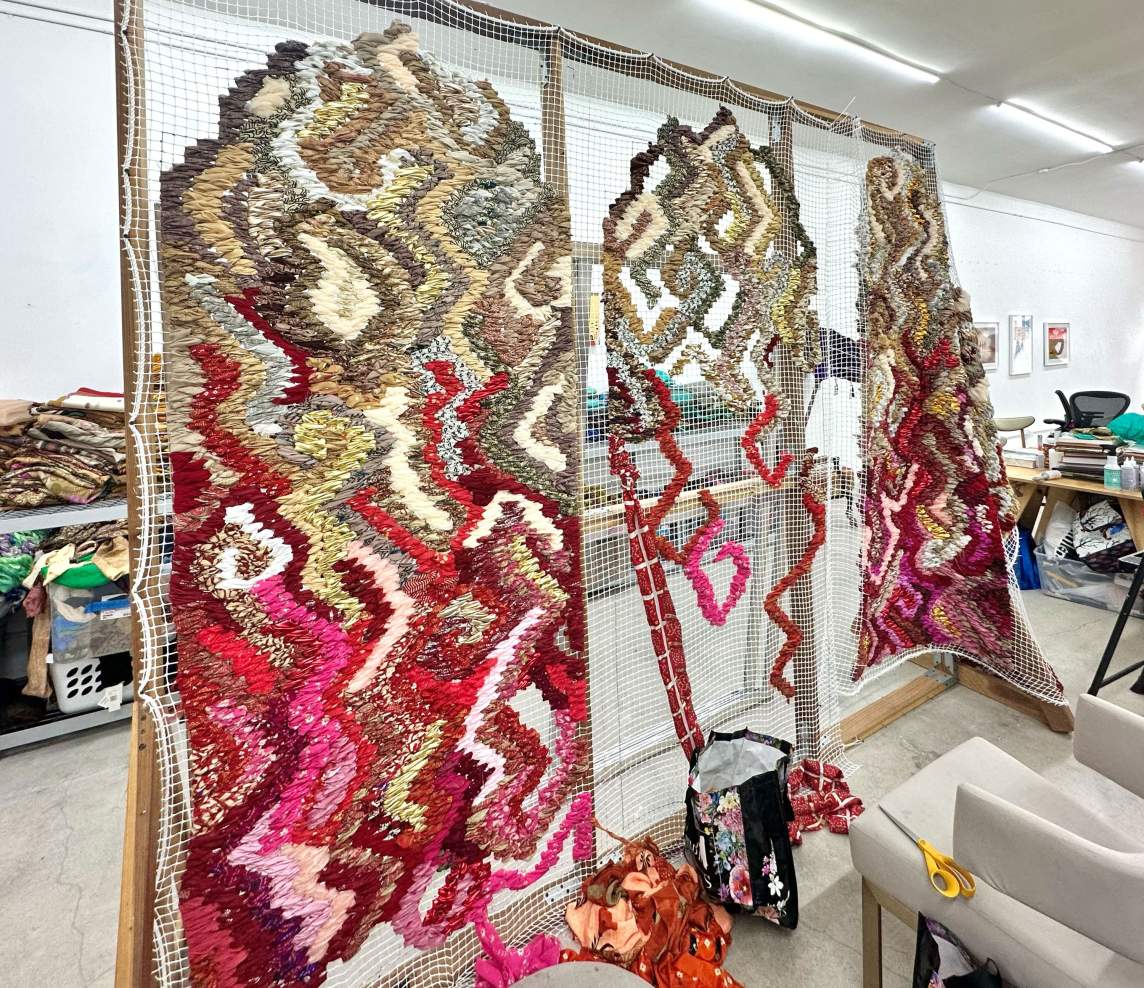
I created a method of "weaving" strips of saris (clothes that South Asian women wear) together into a rope net grid as a means of bringing women of the diaspora together over topography and through time. This can be seen in works like A Cosmic Awakening (2023), which reflects on the Hubble telescope and its possibilities, imagining a mythological future space.
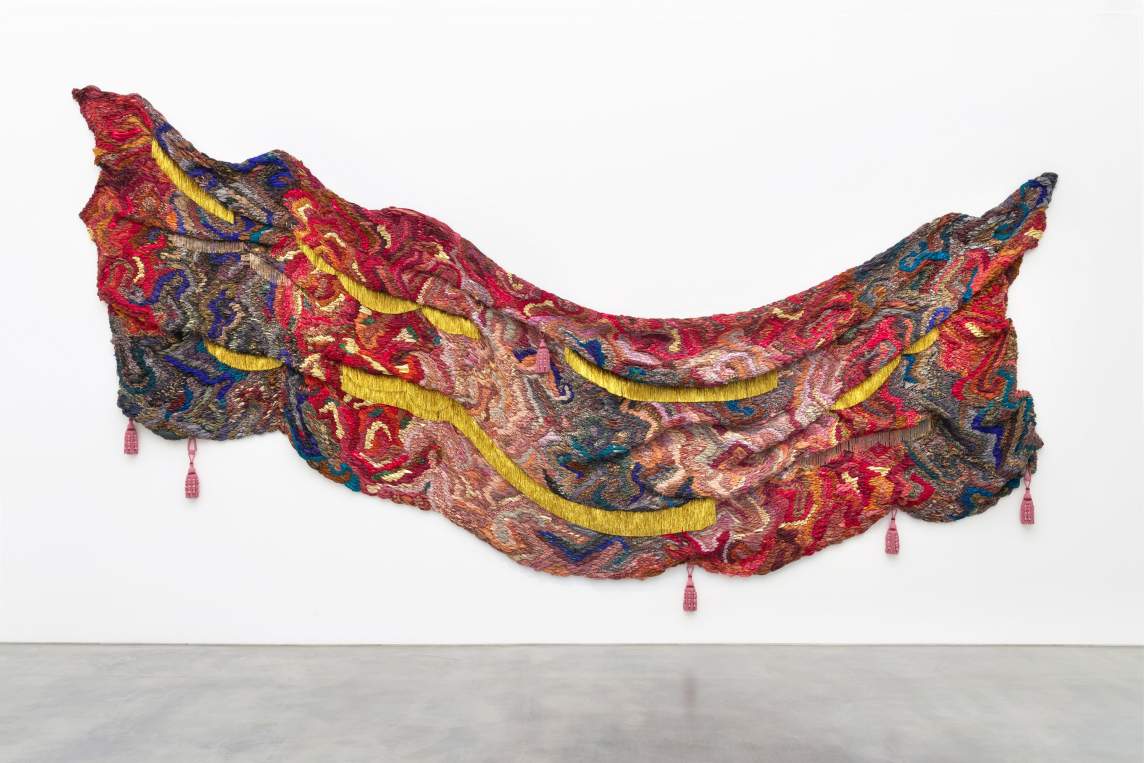
Intuition, material explorations, imagination/visions, and research are all parts of my process. I want to learn something new each time I make a work. My process often changes depending on the scale of the work. For example, in creating Becoming, for my outdoor installation We are Nomads. We are Dreamers at Socrates Sculpture Park, I began by visiting the site and researching the history of the park and its community.
Queens was a site of immigrant communities, including my own. My family and I moved to New Jersey when I was 12. It was the first time I was in proximity to many of my hundreds of extended family members who lived in Queens. My Uncle had a grocery store that we would visit, and it felt strangely familiar, almost like being back at my Dad's family's market in Georgetown, Guyana. We attended birthdays, weddings, funerals, and a Hindu temple. It is with this spirit of community that I created my project for Socrates Sculpture Park. My family had lived near the Atlantic Ocean my whole life and my ancestors had crossed the Atlantic as indentured laborers from India. I wanted to create an installation that was a monument to immigrant cultures—that mirrored their bodies and nodded to collective histories, considering how the East River as a tributary of the Atlantic Ocean was a powerful presence and reminder of ancestral migratory journeys.
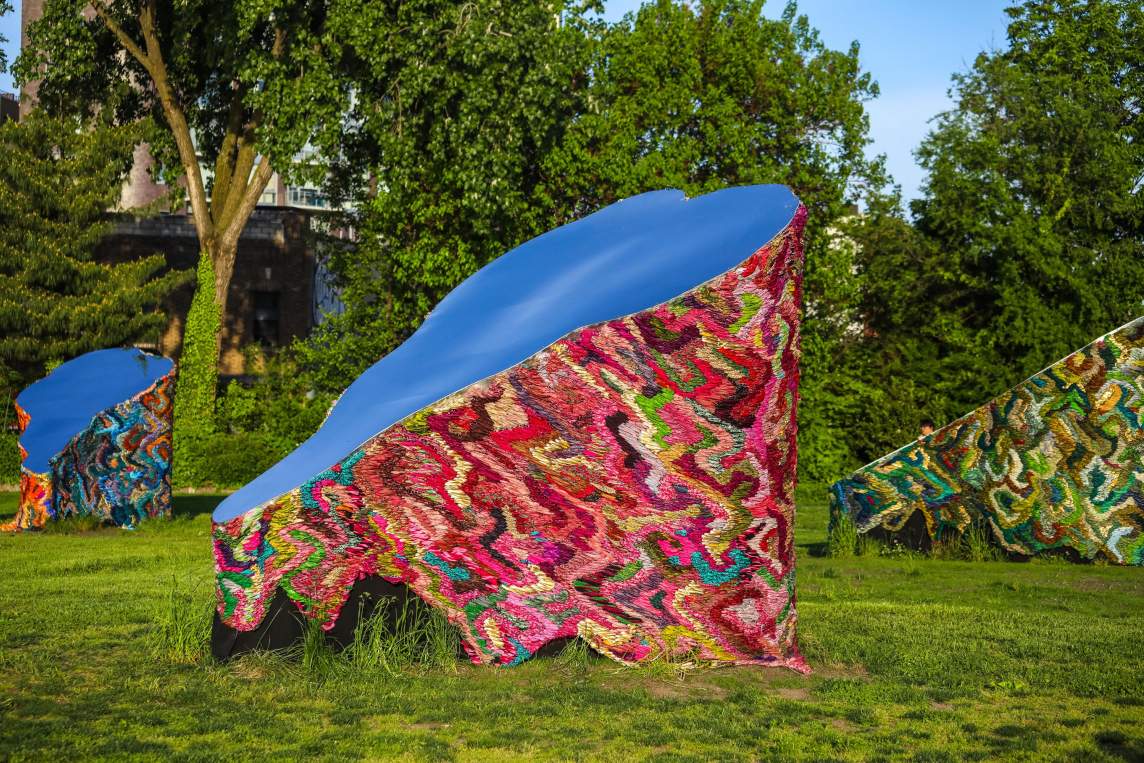
The work that I created mirrored the environment, while simultaneously honoring the labor of women. The installation consists of six futuristic architectural “pods” resembling ancient monoliths that seem to have risen from the earth below. Mirrored material unites the work with the sky and surrounding environment, while woven vintage saris monumentalize the bodies and lives of women of the South Asian diaspora.
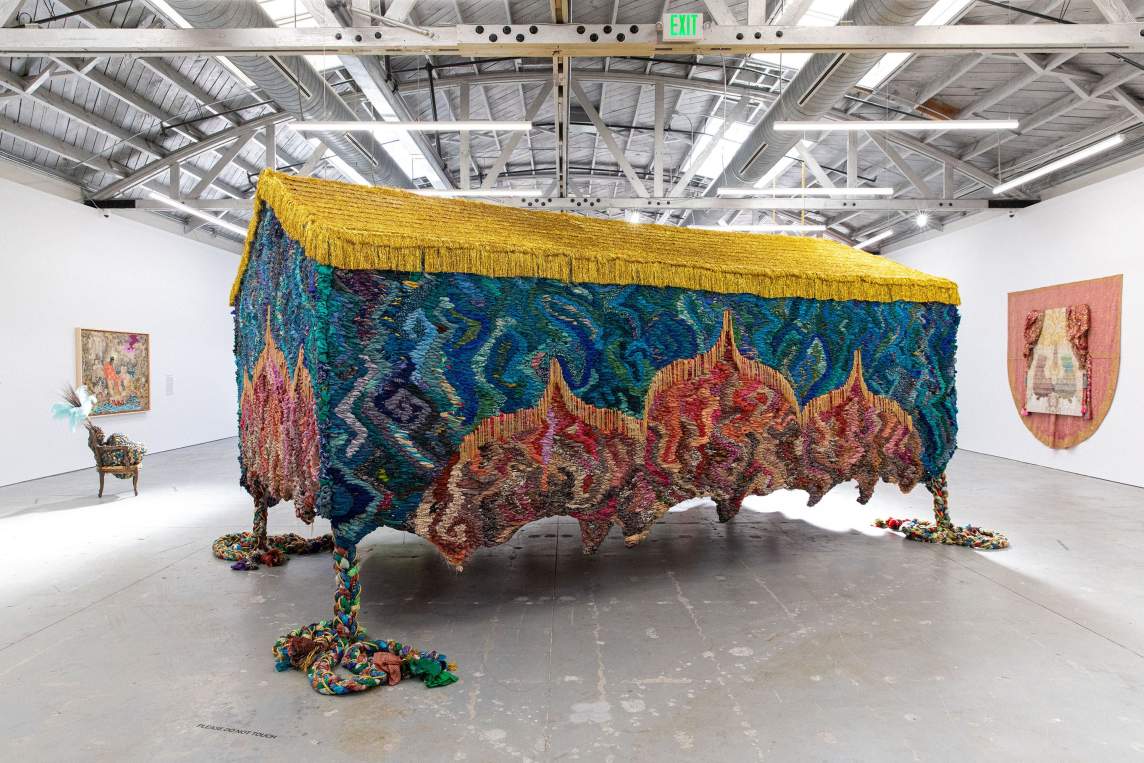
Another large-scale sculpture, Pappy's House (2024), is a replica of my Grandparents' house on stilts in Guyana, where I spent time as a young child. With this piece, I was thinking about the Medieval mnemonic device of using conceptual architecture as a means of remembering and storing information in each "room."
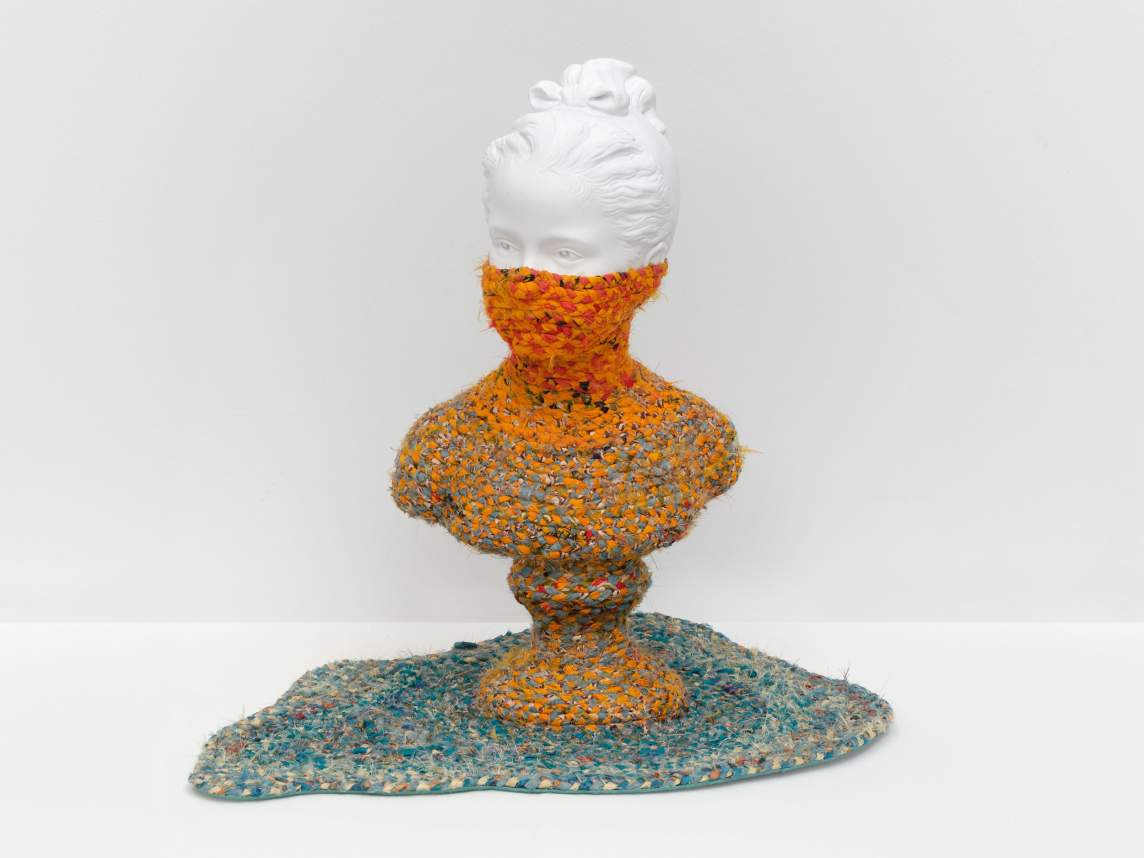
For smaller works, I rely more on intuition and allow my imagination and materials to guide me. Found objects draw me in because of their implied histories and auras. For the work poesis, I was immediately struck by the bust of the girl in a vintage shop and transformed her with sari braids, intertwining Western and South Asian materials. Women's stories overlap in many cultures, and I wanted to highlight those connections. The braids reference hair and the ritual of braiding between mothers and daughters. Poesis in the Platonic sense is a "giving birth," and the creation of art is similarly a "giving birth."
My studio is in Los Angeles. It is a sunlit space where I am constantly inspired by the people walking by and the sounds of the city. The large palm tree outside of my window takes me back to Guyana, where I was born. There are a few workstations where multiple projects are underway.
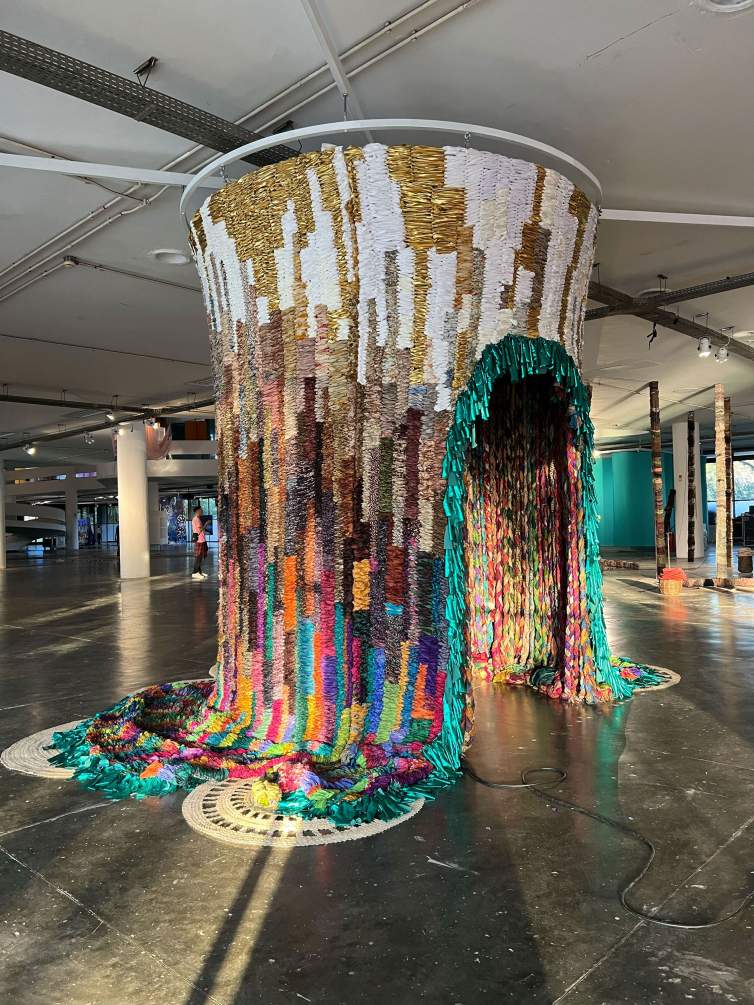
It has been a busy time for me! My piece Siren Song is currently on view at the Museum of Art Rio, in Rio de Janeiro, Brazil, as a traveling portion of the Sao Paolo Biennial. I also have work in a group exhibition at the Buffalo AKG Museum called Let Us Gather in a Flourishing Way, and in an exhibition at the New York History Museum called The New York Sari.
Right now, I’m working on a commission for UCLA’s Fowler Museum for a three-person exhibition, curated by Syona Puliady, that opens this summer. My work for the exhibition explores the possibilities of intersections between fiber, architecture, and monuments. I’m also preparing for a solo coming up in early 2027 at Roberts Projects. The show will be up during Frieze LA.
Artmaking is a spiritual, nourishing, and generative process for me. The love and support from family, friends, community, and strangers feeds me and keeps me going. I want my work to generate emotional responses and to offer connections to viewers’ own lived experiences.
Interview and editing by Jenny Gill. Learn more about Suchitra Mattai’s work at suchitramattaiart.com.