In the Studio: Michael Arcega
“It's this kind of alchemical thing that happens when you abstract a word. It c...

Nancy Friedemann-Sánchez is a Colombian-American artist and 2025 Joan Mitchell Fellow. We interviewed her about her work and creative practice in March 2026. The following is edited and excerpted from the artist’s responses.
I have been an artist for the last 40 years. I mostly do two-dimensional work, including painting and collage, but once in a while, I venture into some kind of provisional sculpture. As an artist, I am interested in the history of Latin America, from before colonization to the present.
I am motivated by what I would call a sense of justice and a desire to create visibility for people and traditions that have been relegated to the margins. I look at the place of women in the world throughout our history—what they have contributed generally, and to the arts specifically. I also have a strong interest in ways of working that get overlooked as being merely decorative or craft. For me, this is a defiance: I can and I will participate.
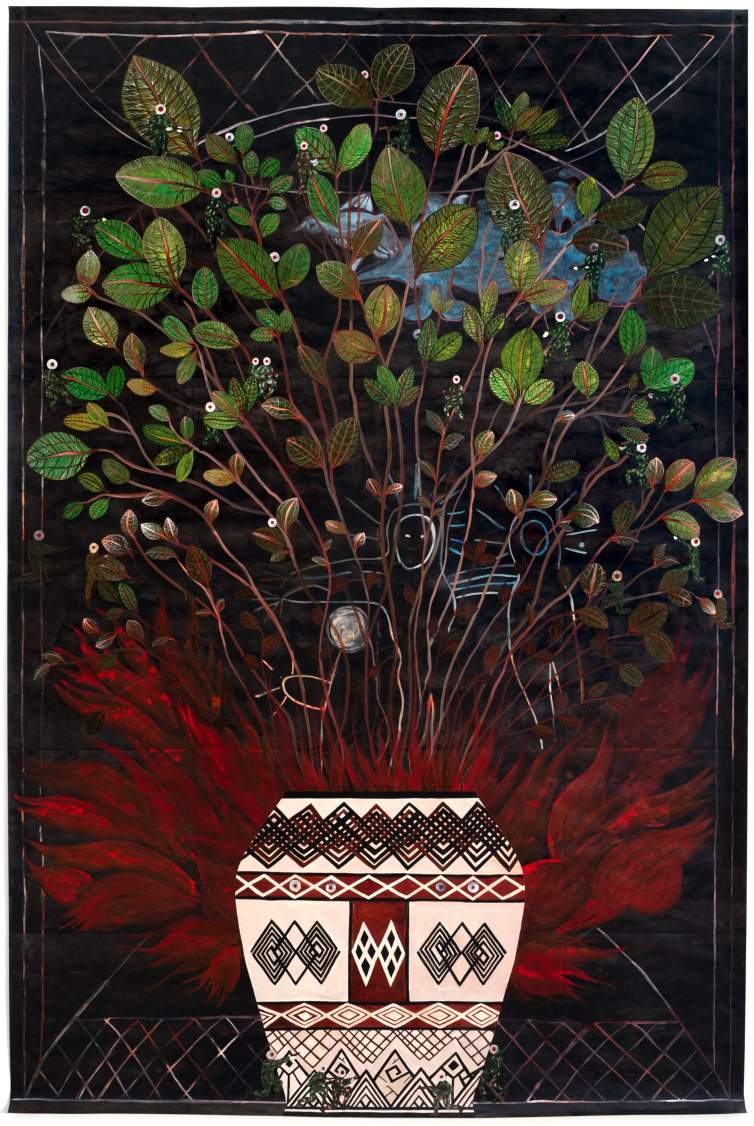
My practice is fairly research heavy. I look at Spanish colonial and indigenous art as inspiration to untangle the legacies of colonization, and my work is often in dialogue with these traditions. I have created my own version of casta paintings, and make work in reference to Colombian ancestral practices like barniz de Pasto, which is a resin-based traditional craft.
I grew up in Bogotá, Colombia, and we had many barniz de Pasto objects in the house: trays, pots. It is a practice that existed way before the Spanish arrived, and it had a huge development during colonization because the Spanish, who were already in commerce with Asia, saw a similarity to Chinese lacquerware.
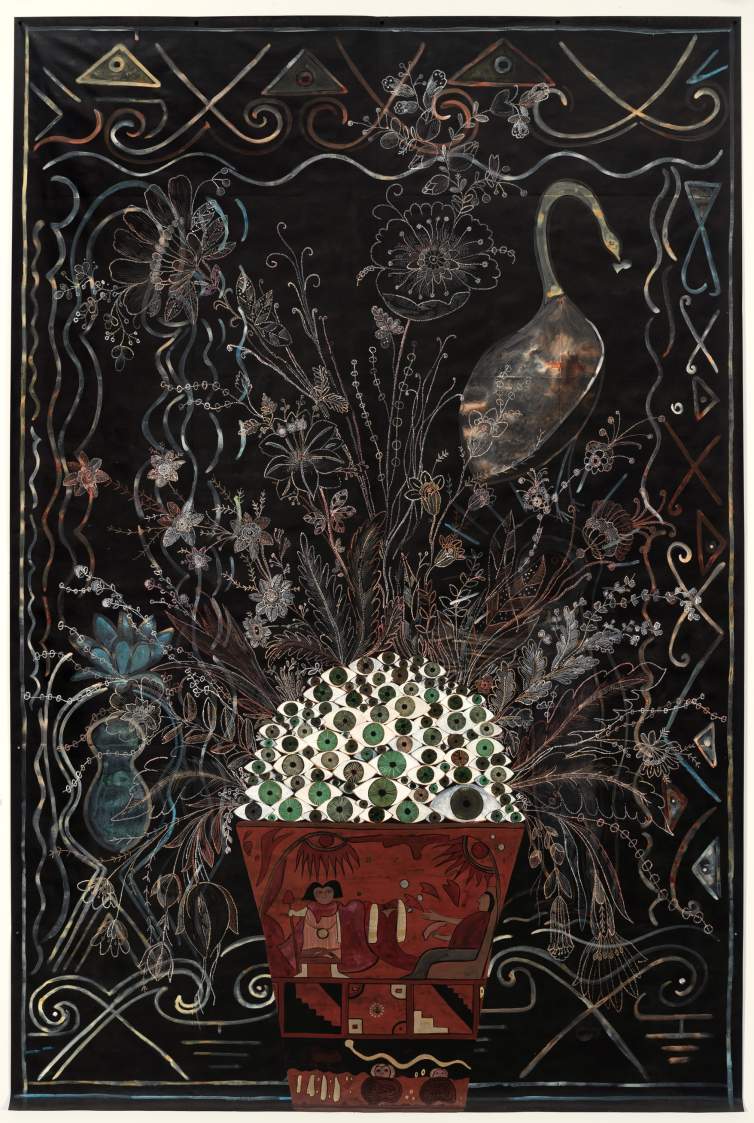
I have been interested in this traditional practice for many years, but had sort of put the idea away when I lived in New York. When I moved to Nebraska in 2011, I started thinking about it again because you really feel the Indigenous presence here—in how people live. It's written in people's bodies. It's written in people's skin. Everybody's mestizo—a mixture. Everybody is a record of that history. You're here in the land of the Ponca, of the Otoe, the Omaha people, the Winnebago. It brought back my own history of growing up in Colombia and the indigenous presence there. I started thinking of this practice again and how I had left that project unresearched, or just in the beginnings, as a metaphor for colonization and the legacies of colonization.
The conquest of the Spanish in Colombia was, in some way, not so dissimilar to today: it was an extraction of the goods of the Americas. They were taking the gold, the silver, plants, animals, everything. Bringing slaves from Africa, enslaving people from the Americas, bringing to the Americas goods that were very coveted in Europe, like lacquer, porcelain, and silk. The history related to barniz de Pasto was that the Spanish arrived and found these people making objects that resembled Asian lacquer. Immediately what developed was this mixture, this kind of syncretic thing, where people were being told, "Make me this object or this chest, and have it look like this." But if you have somebody that is from another continent make something to look European or Asian, something else is going to come out, and I'm interested in that. You have a new cultural development that comes out of that, and that contains everything: domination, and resistance. In some way, that's a current that runs through all of my work.
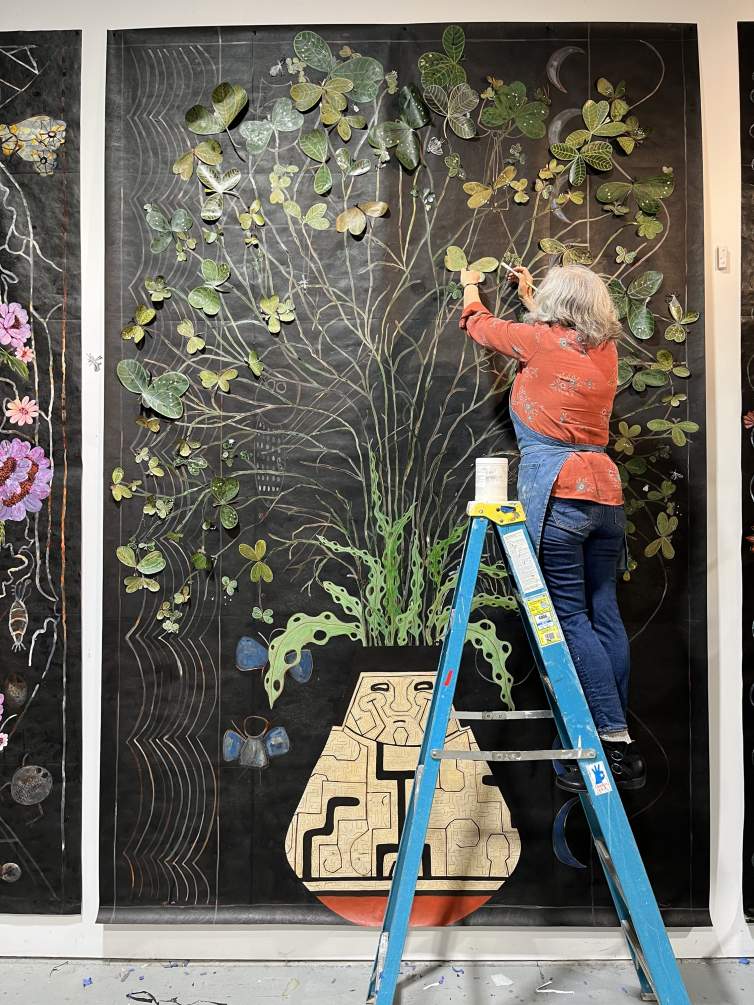
My studio is a prefab, industrial space in Lincoln, Nebraska. I work between that space and my attic. In addition to functioning as my studio, three to four times a year the industrial space converts into the DIY gallery space that I run with my husband Charley Friedman. It has been one of the most rewarding experiences, to be an artist who also curates exhibitions. I lived in New York for close to 21 years, and when my husband and I moved to Lincoln in 2011, we initially thought, "Oh, my God, our careers are over.” We moved to a university town without being university professors. One day we said, “How do we stay in touch with this other world that we built for 20 years?" We decided to open the space and call it Fiendish Plots. We thought “Fiendish Plots” is like “good trouble”—we get to do what we want, present the shows that we want to put on. So we decided it would be solo shows for mid-career artists—for people like us, who have already kind of been around the block a few times, which is a demographic that often gets overlooked.
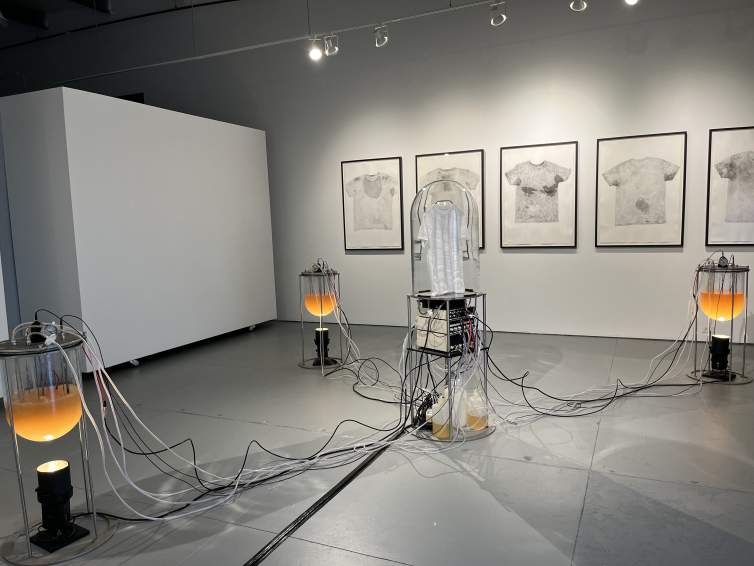
My practice is built upon my having a paced discipline. I work nearly every day. I have structured my work in such a way that I work on smaller elements that I can then incorporate into larger pieces, approaching everything in smaller, more manageable chunks. This is something I have done for most of my career. I also created a way of working that allows me to move between projects to keep things fresh and cohesive. When I get stuck in a project, I will make a left turn and work on something completely different like sculpture or printmaking. This allows me to step away and come back to the threads I left loose, keeping it interesting to me.
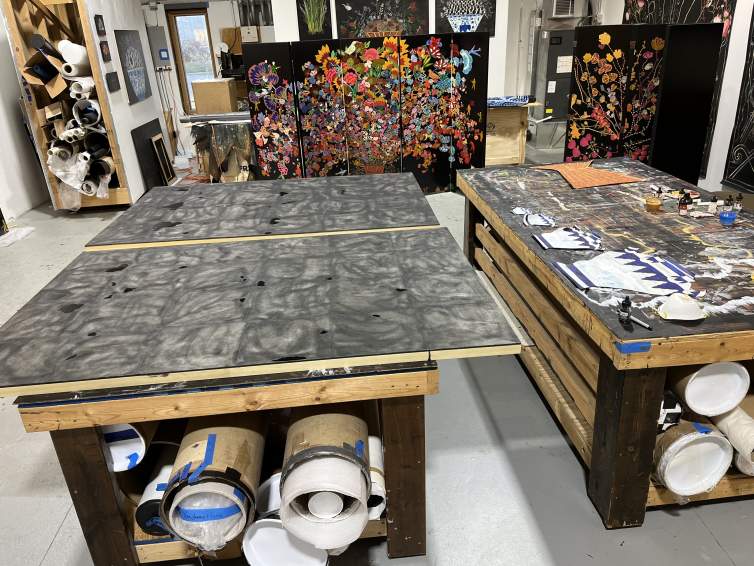
My process is largely based on research and then generating material based upon that. I rarely go into a new piece with a sketch or preconceived idea of what it will be. I study Spanish colonial and indigenous artworks and craft traditions maintained largely by women, and then synthesize that into elements I can later curate and design into a composition, seeking out what pieces communicate with one another and suggest a narrative. My current body of work, based on barniz de Pasto, brings in the research I have done, from which I paint on Tyvek, cut, and collage, imitating the process that artisans use to craft those objects.
I arrived at Tyvek as a material from various directions. I've always liked working large and working on paper, but I found myself needing a paper that would be archival, take the wear and tear of exhibitions, and also allow me to work large. Tyvek fits all of those needs. Also, Tyvek comes out of petroleum, which is part of how we colonize the Earth—how we extract from the Earth as we construct our lives. And so, it all kind of fits like a puzzle—the craft and the content.
The imagery I’m making right now are all still lifes, and I'm thinking of the still life as an important genre during the colony. It's basically a metaphor for the extractive nature of empire: "Here we are. Here are all the goods that we present to you, that we have taken, that are ours now."
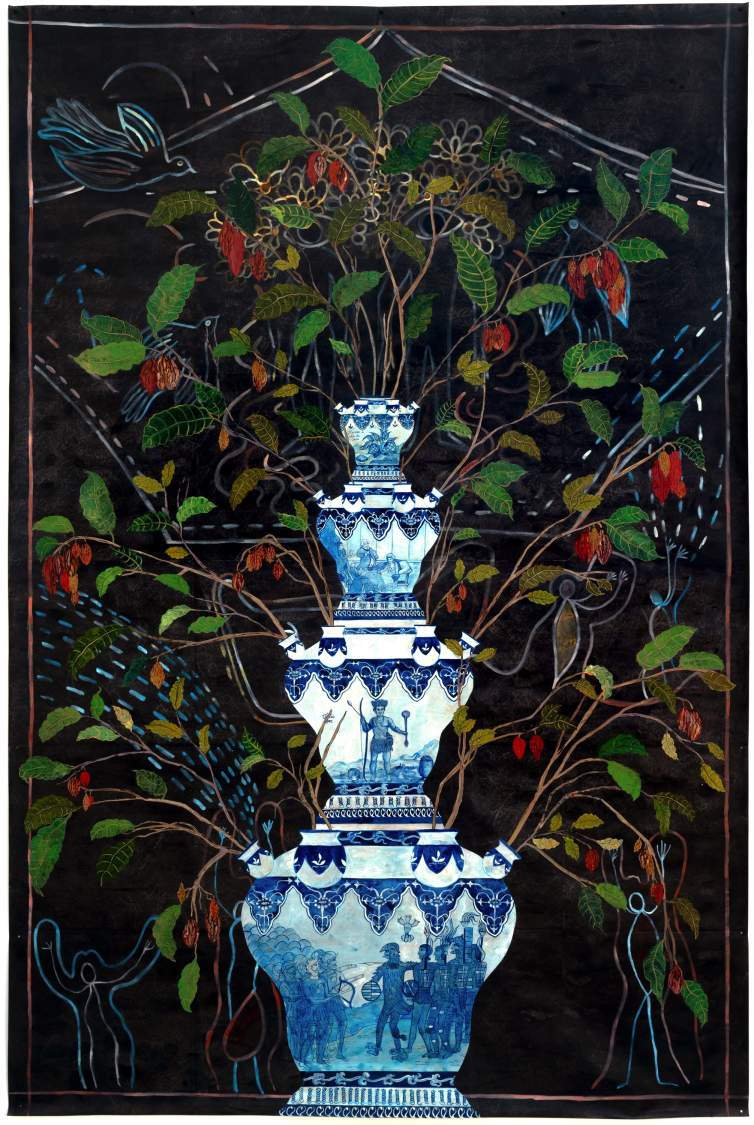
One piece in particular, which is called Dream Map and Cornucopia with Tulipiere, is a multi-tiered flower vase—like four vases that sit on top of each other. I created an underdrawing that is loosely inspired in Indigenous drawings from the Amazon and has these figures that are kind of like harvesting. And then in front, I put this vase that has four tiers, and those tiers are painted like porcelain that was brought to the Americas. On the first tier, I used imagery from the Codex of Duran, where you have a representation of the moment of contact between the Spanish and the Mexicans: these men dressed in metal armature, with these other men in their mythical dress, wearing jaguars. This is the moment of what we call the conquest: the moment of encounter, of confrontation.
Then the second tier is a European drawing of an Indigenous person with a bow and a molinillo, which is like a wooden whisk for mixing chocolate. The third tier shows Europeans drinking chocolate, and then the fourth tier has botanical illustration and writing in French.
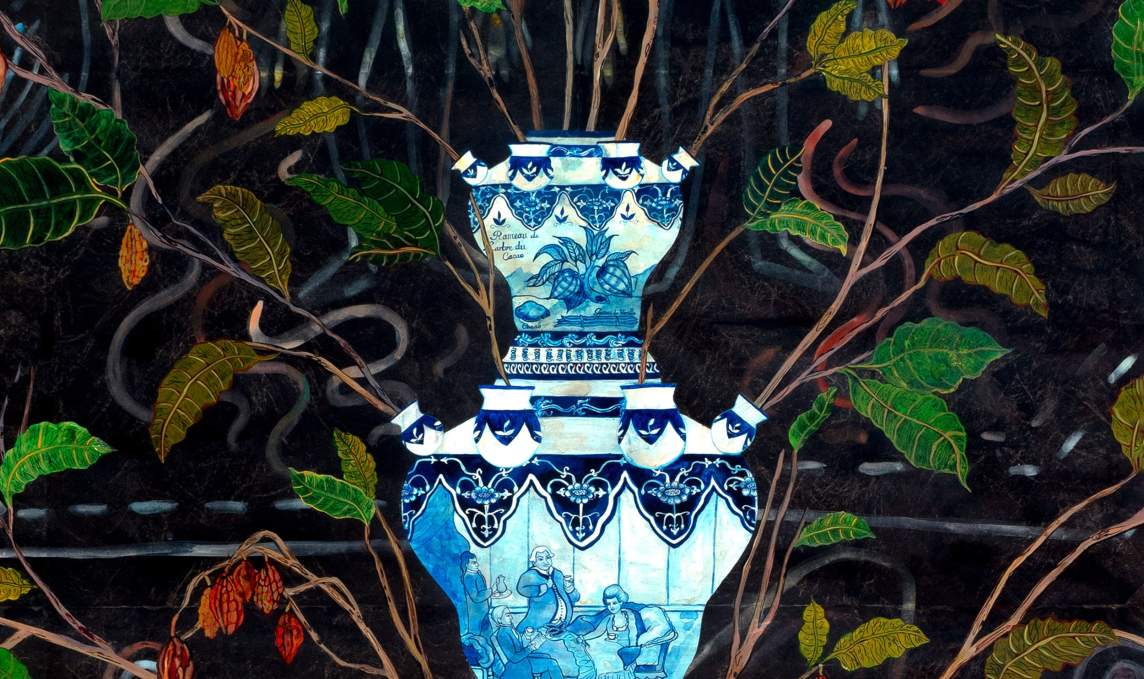
The fruit that is coming out from this tulipiere are cacao pods, and those are inspired by the colonial botanical illustrations made of the American plants. But again, they're European illustrations, and the naming becomes European, goes from Nahuatl to Latin. The chocolate goes from Mexican to Swiss. It's all of these transferences of ownership. The cultural memory is there. So there are a lot of layers in the imagery and the iconography. So many layers.
I've always been interested in doing large work as a way of taking up space and making these traditions visible. I've been interested in women's work from the beginning of my career, and my origins as an artist were really through feminism and the pattern and decoration movement. My interest in looking at colonial iconography came later, as I developed as an artist and I was able to integrate both. In order to do that, I think the work has to be large. They have to reference those traditions by scale, by taking on a heroic kind of place.
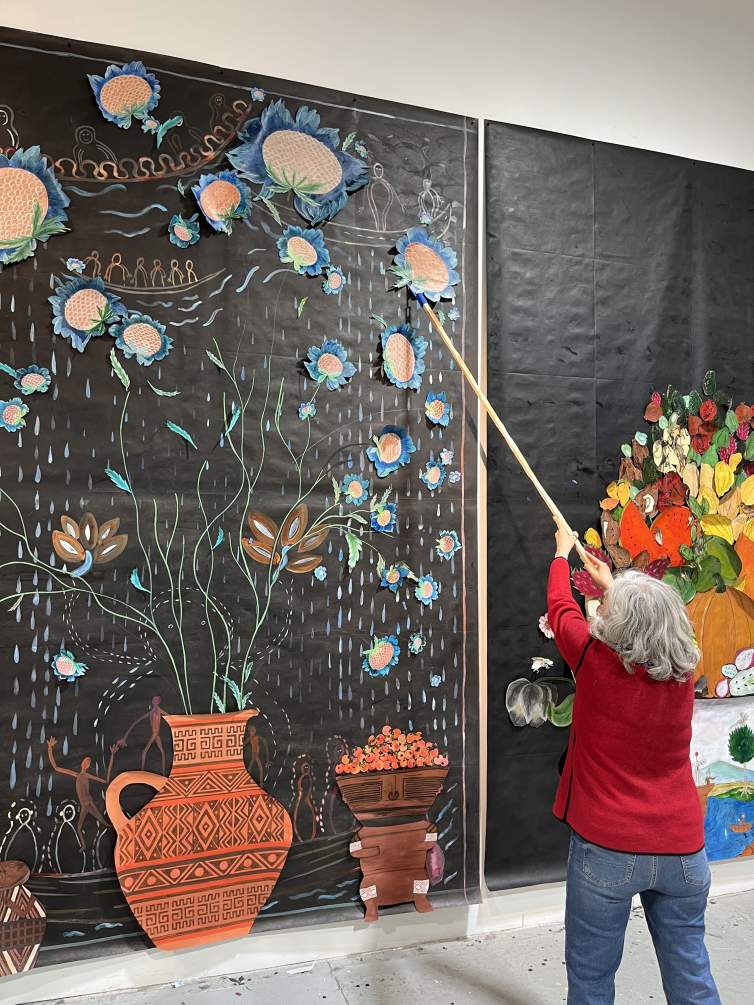
Right now, I’m making work for a solo exhibition at Rebecca Camacho Presents gallery in San Francisco in May. I’m currently in dialogue with a local publication here in Lincoln, Prairie Schooner, to publish a feature on some of my works. I have been fortunate enough to have been asked to contribute an essay for a private accelerator workshop at Harvard University's Radcliffe Institute, (Mis)Labeling Difference: Ecological Frontiers and Agricultural Borders, this summer.
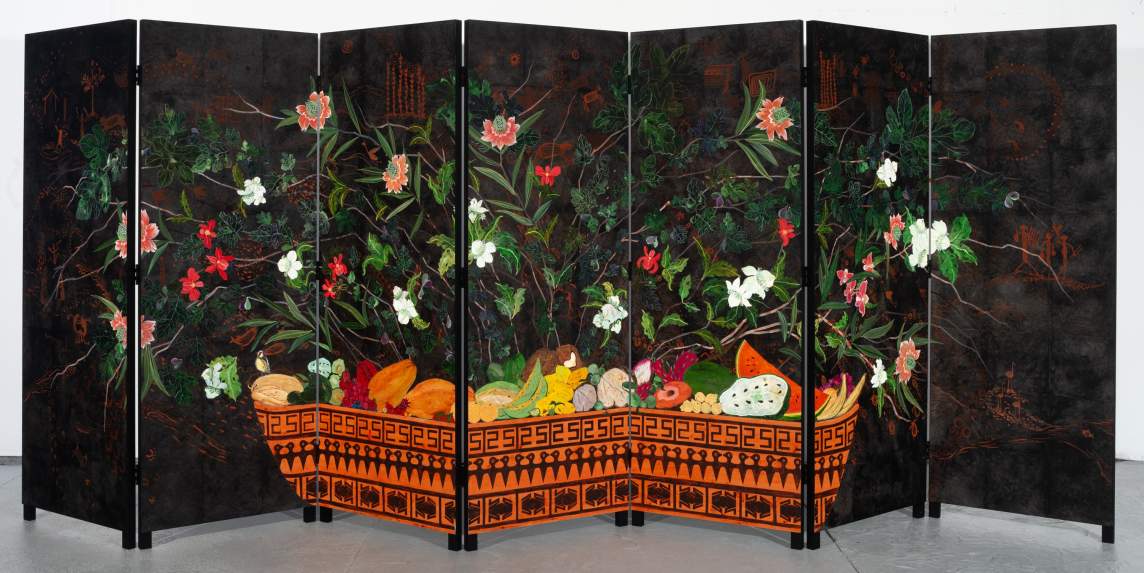
I am also in the process of creating a biombo, or screen, in collaboration with master varnish artisan Mary Ortega, building off of previous works both from my Cornucopia and ¡Mama La Mestiza Me Llama! series. Like much of my work it is exploring the legacies of colonization, cultural memory, the ways in which still life functions as a colonial genre, and the culture of extraction of resources from Latin America.
I was connected to Mary Ortega by Claudia Ramirez in Colombia, who is a liaison between artists and artisans. She heads Artesanías de Colombia, which helps artisans throughout the country reach larger audiences. They work with artisans in Pasto, in the north of Colombia, in the most remote areas of the country, including the Amazon. Mary Ortega is one of 38 artisans left still sustaining the practice of barniz de Pasto, and one of only two women. Claudia saw that I had been doing this research on barniz de Pasto, and reached out to tell me about this government program that connects artists with artisans to make works. They make the connection, but there is no money. I said, “Yes, please connect me. I want to work with a woman.” And Claudia said, “I know the one." I went to a female collector here in the United States to help me raise the money, and I started working with Mary.
The pieces we’ve been collaborating on are screens that are inspired by the Asian screens that were brought in during the colony, when people coveted Asian screens. My idea was to make a contemporary screen that uses still life to depict stories of the war and the legacy of colonization. We have been working via Western Union, WhatsApp video, and I've been to Pasto a couple of times. I make a piece here and then I send her the image in high-res, and she prints it and she copies it. In all of this, there is a transference, something that we share that is super powerful.
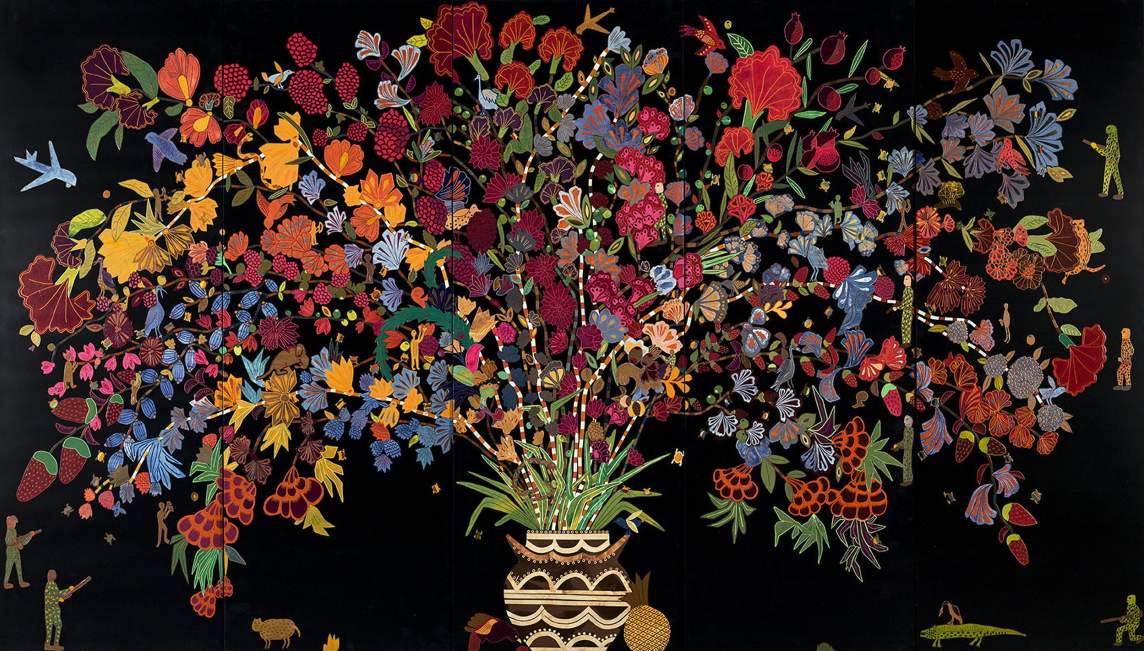
With all of my work, I am building in layers of history, aesthetic references, and narrative that tie the visual elements together. But I really want to work in a kind of democratic mode, and for the work to be accessible. What I hope for when people engage with the pieces is that they feel an aesthetic and emotional pull to the work. I want them to enjoy the beauty of it, look into all the details, have a tactile experience with it, and hopefully for them to pick up on the narratives and references at play. I am always interested in highlighting histories and practices that get overlooked, so if I can also bring attention to that in my work, I have succeeded.
Interview and editing by Jenny Gill. Learn more about Nancy Friedemann-Sanchez’s work at nancyfriedemann.com.