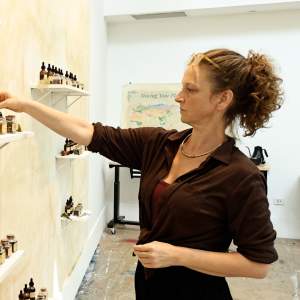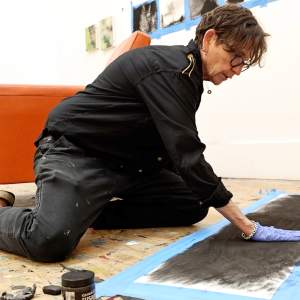
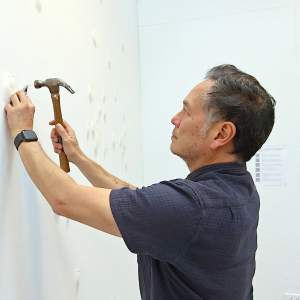
In the Studio: Michael Arcega
“It's this kind of alchemical thing that happens when you abstract a word. It c...
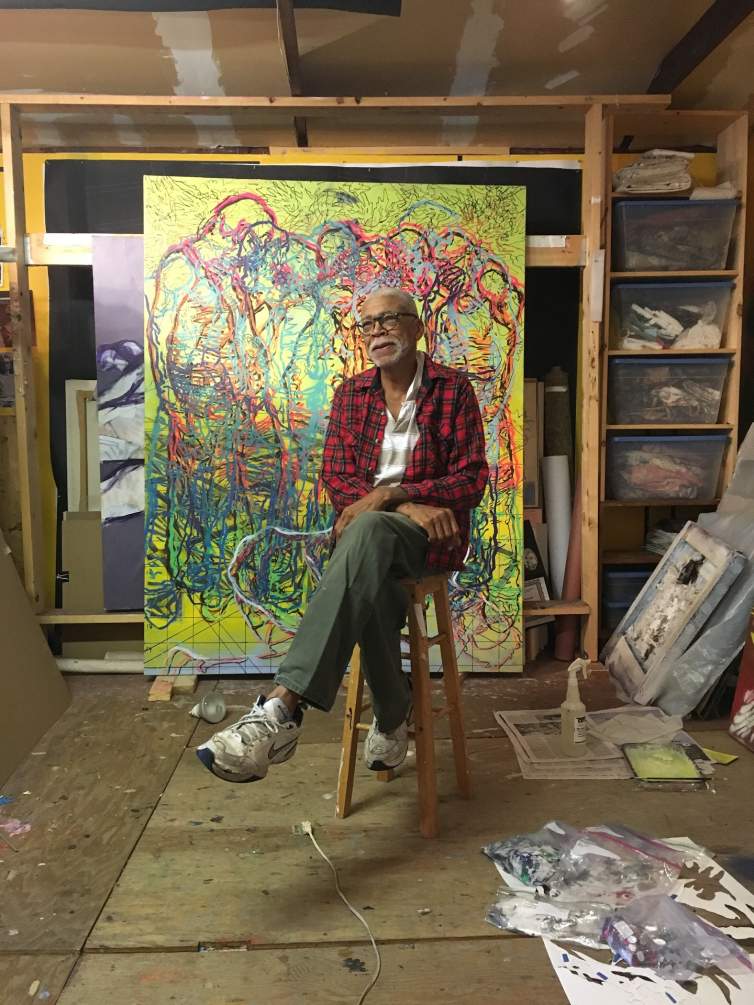
Bob Dilworth, a 2025 Joan Mitchell Fellow, is an artist from Virginia who is now based in Rhode Island. We interviewed him about his work and creative practice in March 2026. The following is excerpted and edited from the artist's responses.
What matters to me most are my communities of family and friends, both in my hometown of Lawrenceville, Virginia, and my current home in Rhode Island. I want to tell their stories, to describe the conditions of their lives, to explain my preoccupation with my Southern past as it comes to terms with my present life in the North. I’m seeking a ground on which to create an artistic vision that brings together the two locations, both real and spiritual, and to think about the distance I have come from those early years to now.
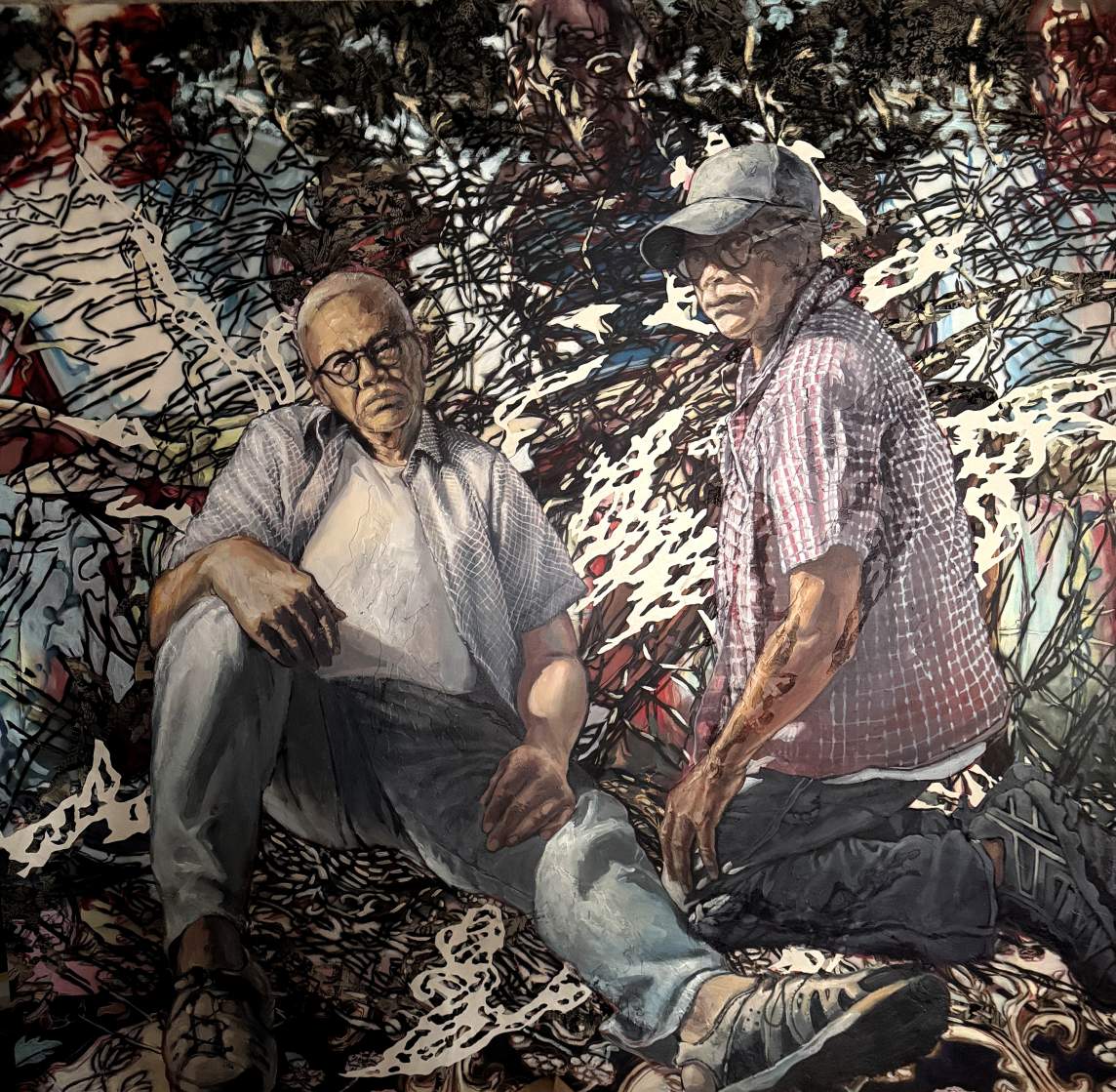
As my practice seeks out memories of time and place, I ask myself, What does it mean to be a Black artist today? Amidst the difficulty of our times—the dangerous, fermenting chaos that seeks to strip members of my community of their constitutional rights and their ancestral history—my work has taken on new significance, making it more urgent than ever. My work addresses how to search for the humanity in each of us, to analyze what exists in us. I want it to act as a marker to help the viewer re-imagine an unknown future.
The first artwork I remember that truly made me see the power of painting was a piece by John Biggers. It was a work belonging to his “Shotgun” series. In it, he told an American story from a Black, Southern point of view. It resonated not just because I was from the South, or that I grew up in neighborhoods with those “shotgun” houses, or that the women depicted resembled the women of my neighborhood, but because it told a profound story in a profound way through the art of painting. I too wanted to tell American stories that were culled from the experiences of strong-minded, courageous, and determined people. I wanted to tell unique stories that provided an opportunity to re-examine my community of young and old, Black, Indigenous, Brown, Asian, LGBTQ+—the many artists of color and ethnic identities who have been on the journey with me as, together, we thrive for inclusion, equity, and access.
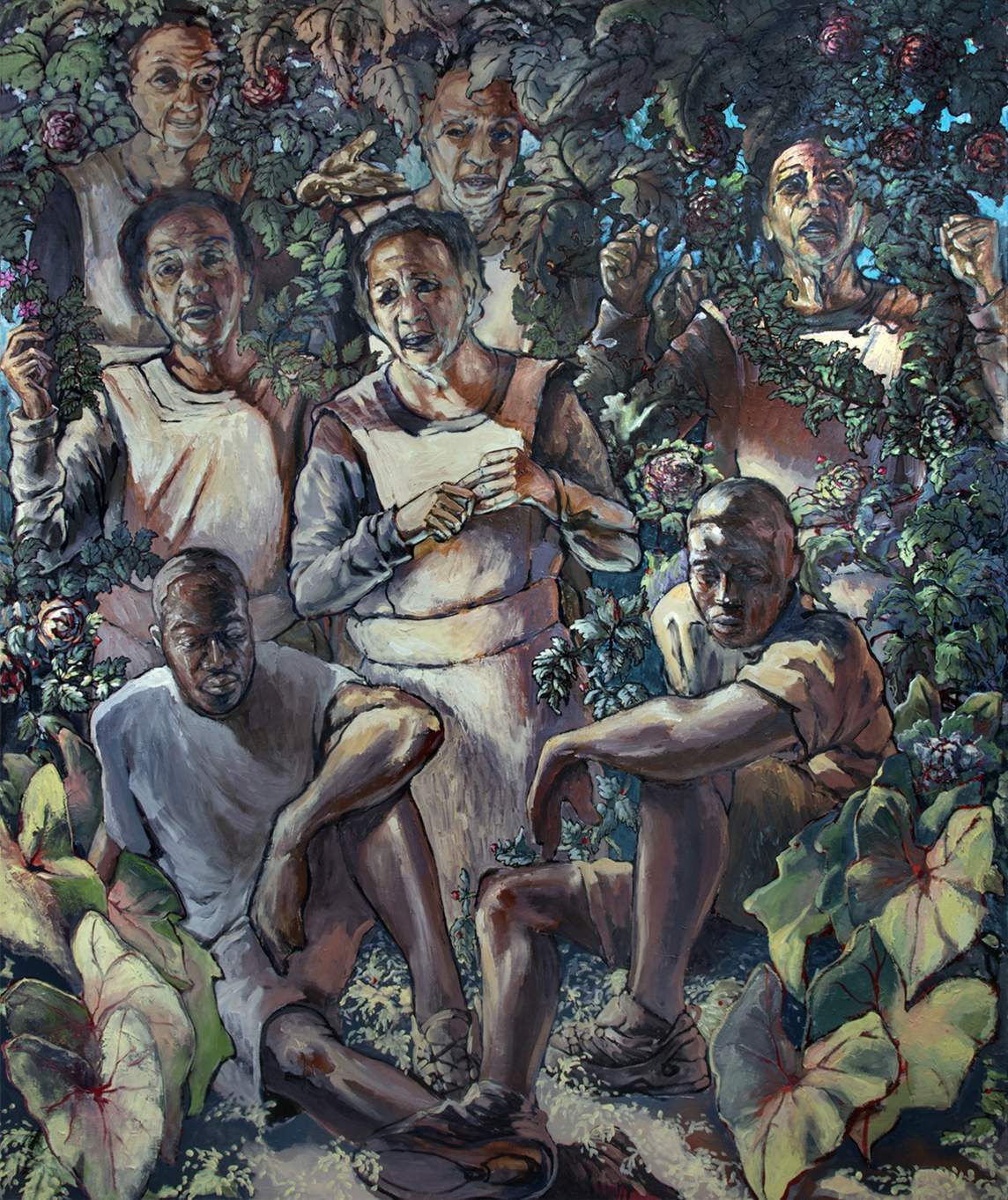
In these times when empathy is branded as weakness, when kindness is demonized, and caring for the marginalized is viewed as reckless, nostalgia becomes a safe, protected, and necessary place to shape and further our destiny. Nostalgia is a place to recover. As I look back on my childhood days, growing up in the Mayfield section of Lawrenceville, I realized that I played a very small role during a brief and fleeting moment of time in a place that is forever good. Not exactly paradise, but a place that made room for us to grow and plan for the future. And for all the young Black kids growing up there during this time, that was special. The town still exists but the culture, the people, the spirit of that era are long gone, except for in the realm of nostalgia.
As I examine the next phase of my practice, I want to inspire my community—to utilize ideas of resilience, restoration, remembrance and preservation to tell stories of triumph and failure, of spirituality and beauty. The idea of community—people of shared interest, of shared experiences (good and bad, failed and successful)—became very important during the outbreak of COVID-19. My own community was hit hard by the devastating psychic and material effects of the pandemic. I start there because it was a time when artists needed each other most and were most needed by the broader society to help define and give meaning to the moment. Many are still rebuilding their lives, as their work proves to be a tool necessary for a way to heal.
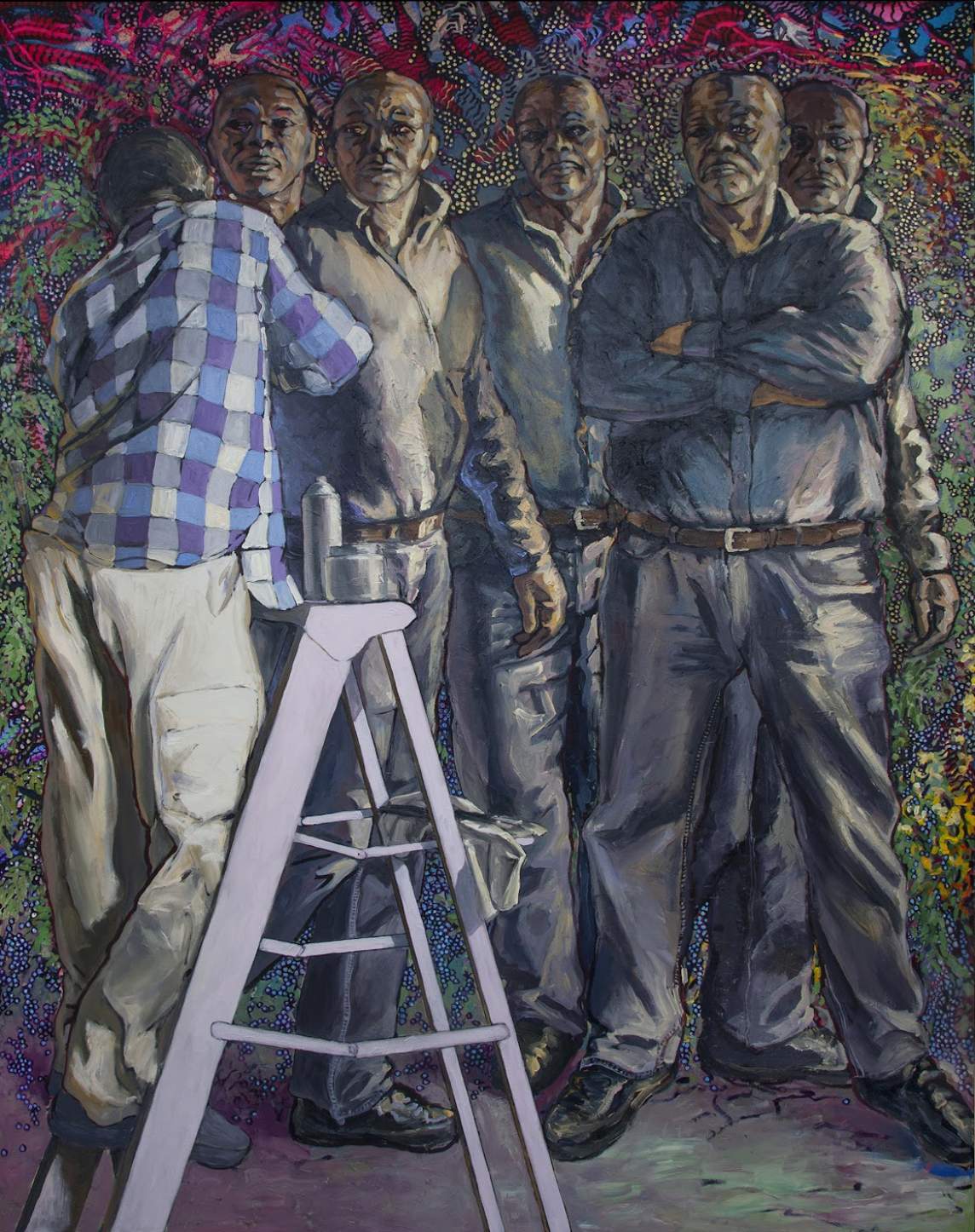
I think what really rose out of this were safe places to work and practice creative activism, to share thoughts, and to sound out challenges and achievements. Public art, art co-ops, self-help, open studios, pop-up galleries, and artist support groups—that were once non-existent—flourished and became creative catalysts for social equity and action.
As a new crisis confronts us today, there is a greater need for artists to stand together with community and allies to defend truth and fairness. My work is dedicated to uplifting histories and traditions that empower a straightforward, upright, and serious view of our world.
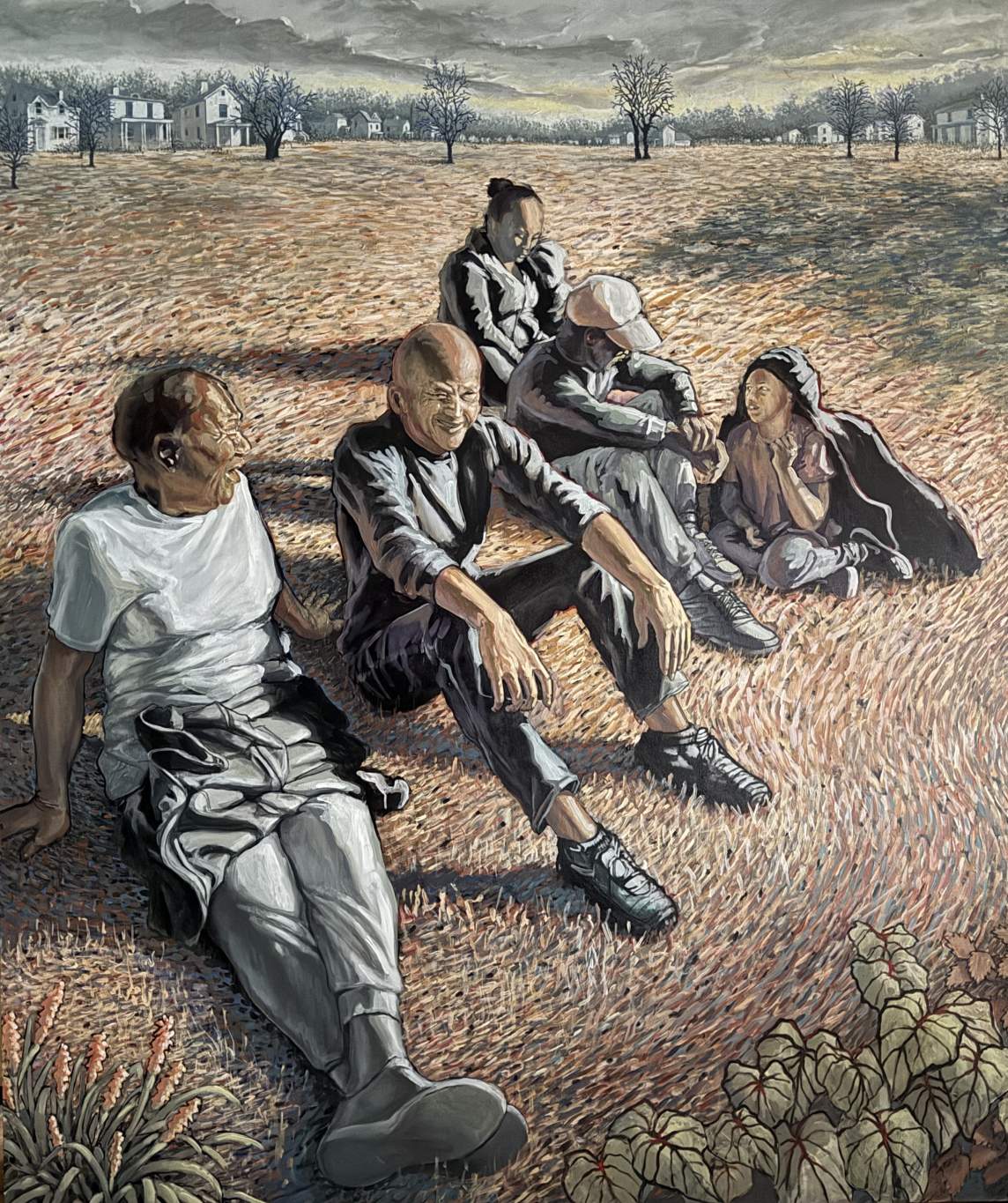
My family is centered in my paintings. But it could be any family. In The Field, my mother, the dominant figure in white, leaning back and casually talking to my brother, occupies the lower left corner. Another brother to the right of the center figure talks to our niece, and my sister-in-law holds her grandchild at the top of the triangular grouping. They sit in a field that has turned autumn brown. Their shadows are long, implying the lateness of day, or perhaps the lateness of life. Above, the town in the distant background, is enveloped in wintery gray. Storm clouds threaten. The shadow of a tree can be seen in the upper right portion of the painting, suggesting the presence of spring. Flowers at the bottom, touching my mother’s feet, hint at summer approaching. All four seasons are present at once in this depiction of a generational assembly. This is not about yearning or sentimentality, but about fortification. As we continue to experience the chaos and destruction that surrounds us, the best way to fight against it is to stay protected by the good memories that sustain you, keep close to the family and friends that support you, and expand the ideas that will propel you to excellence.
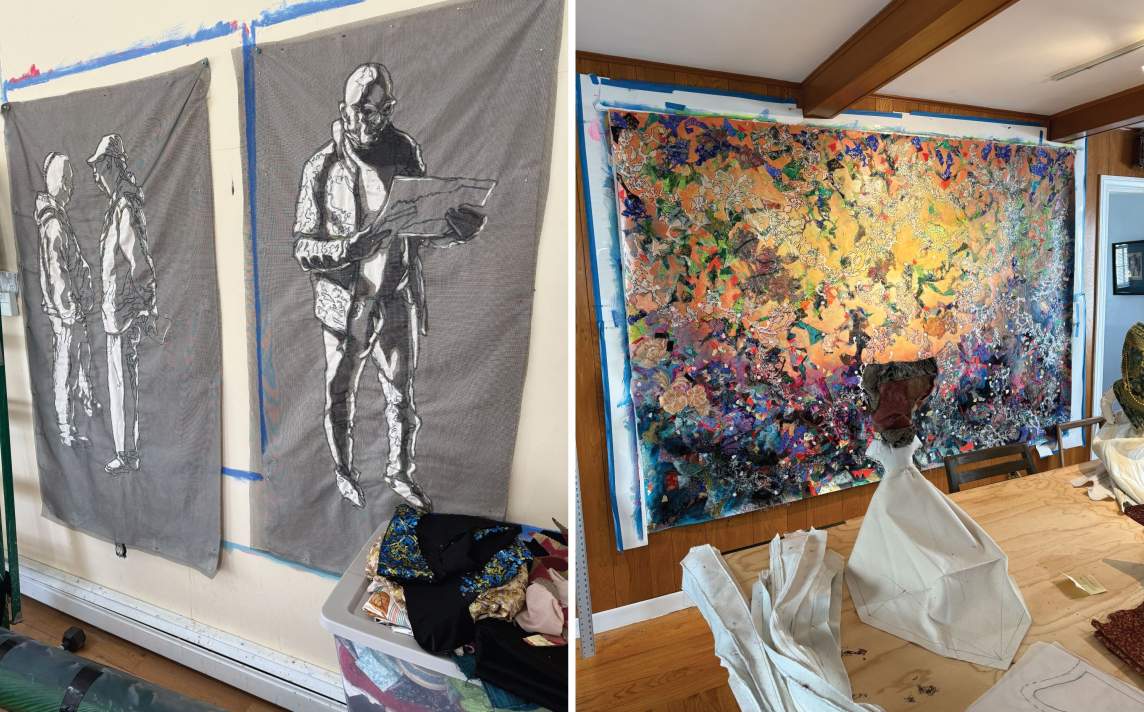
My primary studio is a converted two-car garage that sits behind my house. It felt huge when I first moved in. The year was 1996. Life wasn’t easy then, nor was it necessarily hard either. I had just started teaching at the University of Rhode Island, I had two young kids—a boy and a girl—and I desperately needed a place to work now that I had a steady job. The house, which came with the detached garage, was perfect. I immediately began converting it into a studio.
A friend helped me remove the garage door, frame in the opening, add windows and another door across the front. We insulated the open walls. Soon afterward I asked another friend to help rewire the open space for track lighting in the rafters and other kinds of electrical needs. (Much later, I realized that the outlets should’ve been installed higher so that they wouldn’t be blocked by canvases. So, I ended up with many outlets I couldn’t access.) I bought a wood stove for heating.
Not much has changed in the space since that time, except that the studio now appears much smaller, more cluttered, and a little outdated. It still serves its purpose well. Along with my garage, I've now converted a portion of my house into studio space as well. With the scarcity of housing and work spaces today, those of us who are lucky enough to own homes are doing this. I couldn't afford to buy the house I live in today, let alone rent or own a separate work space. Because of this, I advocate for affordable rents, housing, and work spaces for artists. Many of my friends have carved out a place in their living rooms, bedrooms, or kitchens to make art. We talk about that often.
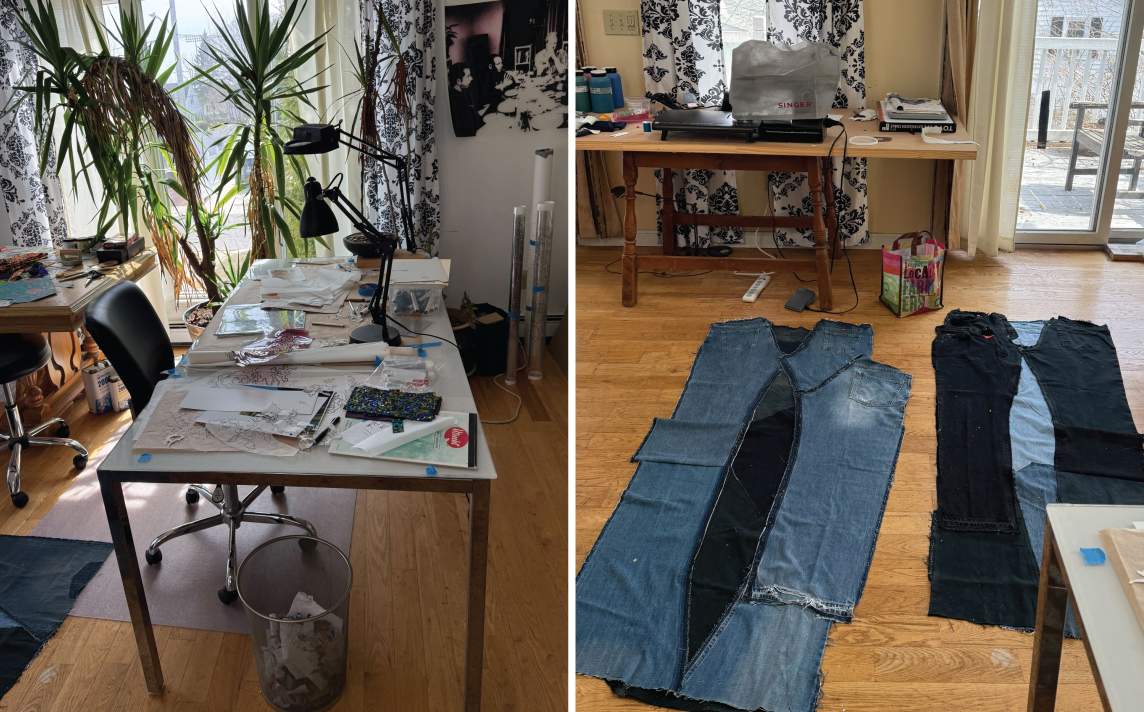
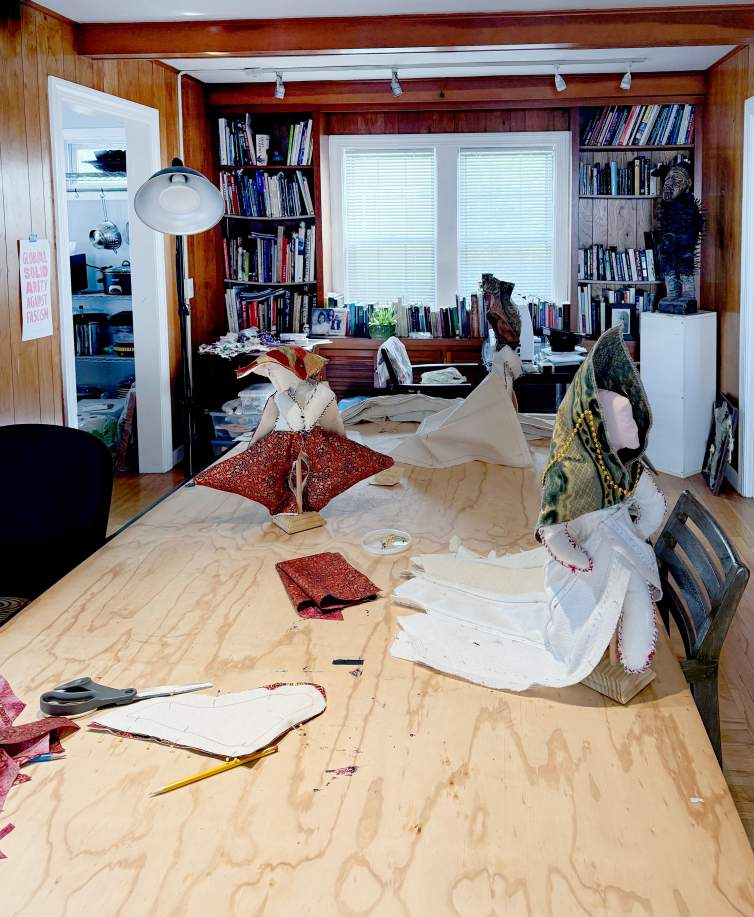
My painting practice takes time, some pieces up to a year to complete. Recently, fabric and the challenge of working with a sewing machine have become sources of inspiration for me. I have been teaching myself how to sew, and am still learning to navigate the machine and understand textiles. I currently own four sewing machines and am planning to purchase a Juki soon. I also recently purchased a quilting table that makes free-motion sewing more flexible and easier.
To push creative boundaries, my sewing practice has turned to working solely with clothes that once belonged to my father, mother, other family members as well as friends. I sew by hand and on machines to tell their unique stories. This felt inevitable. My mother, as a young woman, sewed hoop skirts—long, bell-shaped skirts, supported underneath by rigid slips that flared out at the bottom. Later, she continued to sew, even though it was pretty much relegated to mending socks, lengthening pants legs for her growing boys, and making kitchen curtains. I grew up watching her sew. My grandmother also hand-sewed beautiful quilts for us that made a big impression on me.
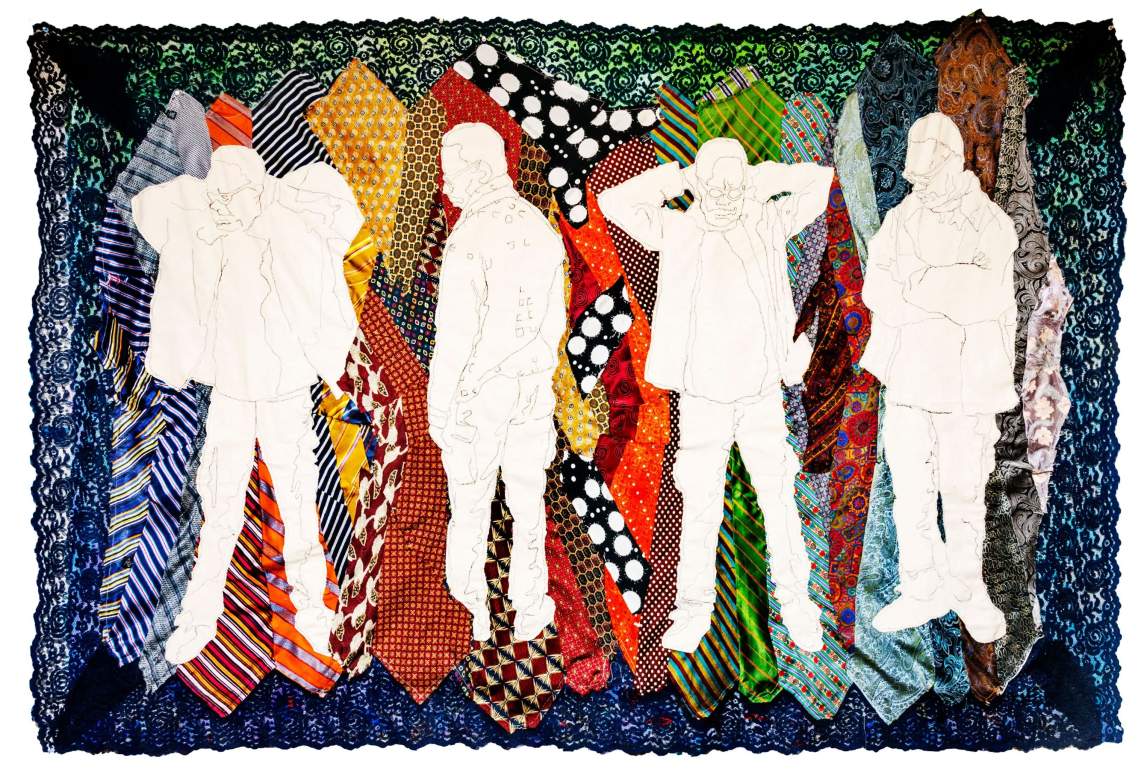
Spontaneity, chance, and discovery drive my most recent work as I find different ways to reuse the materials while learning new processes. A good example of this is seen in the work titled Tie, where the silk ties in the background once belonged to my father. How he ended up with so many isn't clear. He didn't wear ties often. He wasn't much of a church goer, and he seemed to manage not to have one on at special occasions like weddings or funerals. I rarely remember seeing him with one. Yet, he left boxes of them when he passed in 2015. Perhaps they were possessions handed down from generation to generation, from father-to-son, and finally to my dad, then to me. But the idea of him inheriting them fascinated me. I stripped, ironed, and sewed my father’s ties together to create a process and make a statement about the ties that bind us. The contrasting figures sewn on top are cut from cotton canvas with defining features stitched in black thread.
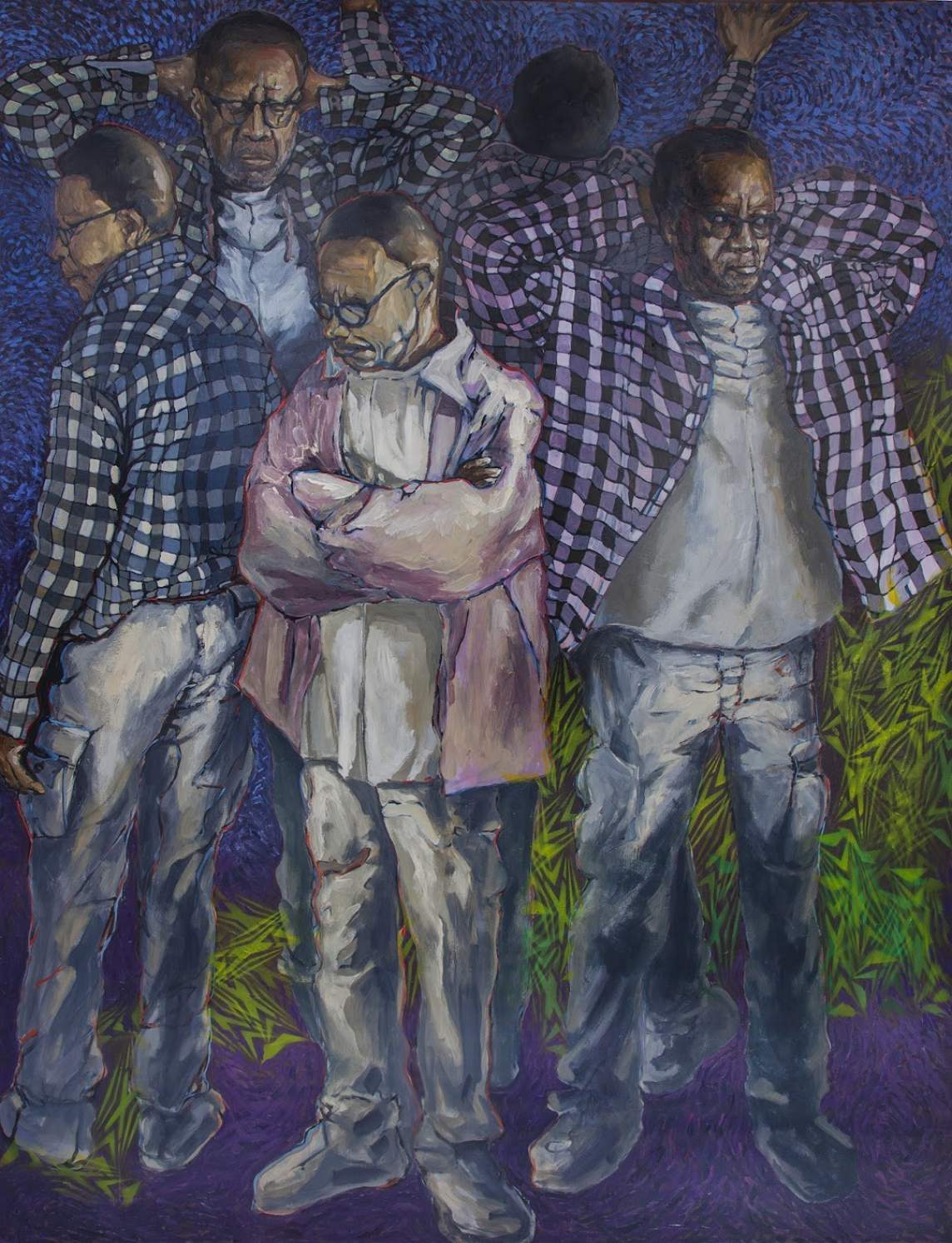
This work pivots off of an earlier painting titled Camouflage. The importance of line drawing, mark making, and contours are visible in all my work, and with the emergence of this newest fabric process, the drawn, painted, and sprayed lines have become a new element: thread. I have studied many quilting techniques and have seen many geometric and symbolic designs to understand the nature of hanging and stretched materials and how they might carry a visual narrative. Over the past 6-7 years of working with textiles, I have developed a scale that feels right. My current textile works are in the range of 8’ x 10-12’.
Right now, I’m focused on preparing for a show coming up at the University of Georgia—an exhibition with Ben Jones and Leslie King-Hammond, which will be on view August – December, 2026—and a solo exhibition at University of Rhode Island, which will be in winter-spring, 2027 (dates not set yet). I also have an exhibition in the office of the Mayor of Providence, RI, Brett Smiley, June – September 2026, and I’m looking ahead to a residency at the McColl Center in North Carolina in Fall 2027, where I plan to focus on printmaking.
In addition to that, I will also be participating in the next Sail Design Art Cup, benefitting the Newport Art Museum and Sail Newport, both institutions residing in Newport, RI. It’s the first year of this collaboration. I have been invited, along with 10-15 other artists, to submit designs to be printed on the mainsail and jib sail of a Shields sailboat for the Cup race, which is taking place in 2027. Each sail has a triangular shape, 33 ft high, and 13ft and 10ft (respectively) wide at the bottom. With Rhode Island being a major contributor to the Trans-Atlantic Slave Trade, my designs pay homage to those who perished during the many voyages from the shores of Africa to the Americas. The Newport Art Museum will exhibit the selected designs this year in a show running from June 4 to December 30.
Alongside these opportunities, in the coming years I plan to create a series of new large-scale textile works made primarily of ephemera, fabric, pieces of clothing, and other material that once belonged to family and my community of friends in Rhode Island and Virginia. Created through sewing by hand and on machines, this series will tell their unique stories while blending with overarching stories of American history and place. I plan to split my time evenly between my current home (Providence, RI) and my birth home (Lawrenceville, VA) for this project. I have located a workspace in my Virginia community that will accommodate the scale of these works, which I envision to be roughly the same size or larger than my current works. I plan to have sewing machines in both locations, and I hope to get an additional quilting table for the Virginia space.
In addition to creating this new series of large-scale textile works, my intention is to meet community leaders in Virginia, seeking new partners and community support to create new oral histories, photos, audio and video recordings, drawings, and sketches—all resources I’ve used before. This project will give rise to conversations that center on how we might meet today’s social challenges for positive change, and create a space to re-imagine new possibilities. I hope to create dialogue around notions of spirituality, of healing and helping, of wellness and mindfulness—all themes I have explored in previous projects.
I envision hosting additional community talks and workshops as the textile works are being made, centering on why I have returned to work in the community of my birth. I will discuss my practice over the years, what has led to my artistic approach, why I use these materials; we will discuss the stories I wish to tell, and why it’s important to tell them. I hope to share and highlight the level of growth and learning I have gained through past experiences and similar community projects.
I intend to work with local leaders and establishments to keep as many of the works made from this project in the community as possible, seeking exhibition and display opportunities with local schools, community centers, and museums.
Interview and editing by Jenny Gill. Learn more about Bob Dilworth’s work via Cade Tompkins Projects.