En el estudio: Michael Arcega
«Es como una especie de proceso alquímico el que se produce cuando abstraes un...
Isabelle Garron es una poeta afincada en París, Francia. Ha compartido la siguiente reflexión sobre Joan Mitchell y su taller de escritura colaborativa con otros poetas en respuesta a la obra de Mitchell. A continuación,extractos de tres poemas posteriores al cuadro de Mitchell The Bridge (1956).
Descubrí la obra de Joan Mitchell a mediados de los noventa, a raíz de una conversación con Jacques Dupin en el contexto de mi investigación académica sobre su escritura sobre artistas. Me siento unida a Joan Mitchell por su gesto, su relación con el color, la audacia de su apertura de las formas a un cambio de perspectiva al margen de cualquier afiliación.
La experiencia de sus obras es la corriente imparable 1 que irriga el poema que busco, al igual que el ejemplo que ella da de habitar un mundo 2 como artista, arriesgando toda la energía que nos da nuestro cuerpo para manifestar su forma y su canto.
La pintura de Joan Mitchell ha dejado huella en la poética de muchas mujeres poetas que conozco. Ella es una de las referencias esenciales en nuestras conversaciones. Pienso en Catherine Weinzaepflen, cuya escritura está impregnada de paisaje, pintura y color, y en las poetas estadounidenses E. Tracy Grinnell y Eléna Rivera.
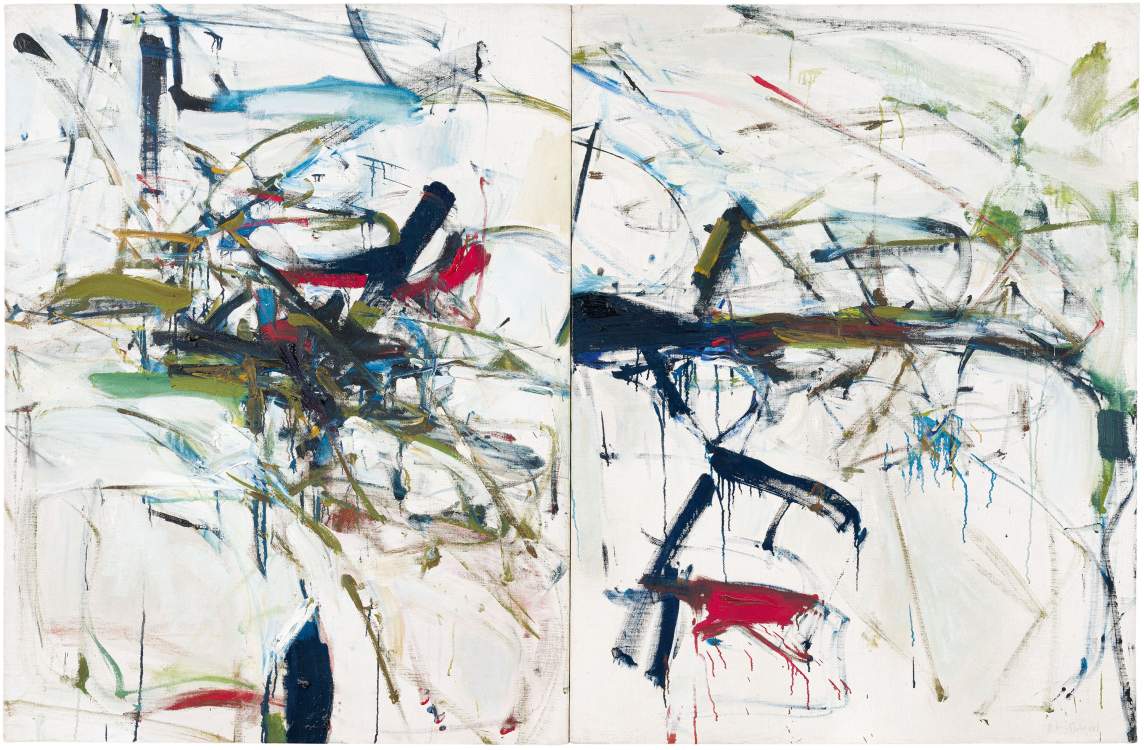
Hace dos años, Eléna, Tracy y yo iniciamos un proyecto al que nos referimos entre nosotras como el "proyecto Mitchell" Es una especie de taller de escritura a tres, siempre inspirado en una de las obras de Joan. El cuadro que desencadenó este proceso es The Bridge (1956). Utilizar The Bridge para inaugurar este proyecto subraya nuestro deseo de inventar puentes inéditos entre las bellas artes y la poesía. También estamos pensando en utilizar el título The Bridge para una revista en línea que queremos lanzar con la ambición de compartir el vínculo entre la poesía contemporánea y la obra de artistas femeninas.
Lee el original francés aquí.
Dans un lieu avec le pont en contrepoint
intérieur d’où je reviens
et de longer la mer
la promenade inscrit
l’absence de pont
le bord dessine
de l’ouvert construit
courbe ce qui sépare
fluctue au vent
elle au fait du ressac
lintérieur d’où seule l’île
de l’autre côté et un homme
en contrebas sur les galets
et la forme graphique
de son corps le bâton
qu’il lance à son chien
dans l’air sur les galets
vers le large
en l’absence de pont
intérieur d’où partent les mondes
les yeux levés vers la flèche d’un avion
elle marque le bleu d’en haut
baignée de la couleur
non rêvée du dedans
je reformule le diptyque
de Joan et son geste
là où il fend
par le jet et la trace
intérieur face à deux toiles
disposées côte à côte
d’où la séparation souffle
et laisse entrevoir
face au désir architecte
de ne pas ajouter
d’autre espace à l’espace
je note comment dire
l’ensemble tenu qu’elle lacère
face à la séparation dans l’unité
à cette unité dans la distinction collée
de deux surfaces peintes
et une fêlure sans éclat
de face tout concorde
et rien ne concorde
la présentation du séparé
le pont nommé d’un lieu
sans figure et rehaussé de rouge
after Joan Mitchell’s The Bridge
1.
The way rapture is tinged
with a strip of paint, streaked—
I’d like to turn, tip
toward the second panel
cross the bridge, strip—
***
Chose to cover two canvases, not
one only it rips certain ideas of “art”
& still has to feed the body—
les couleurs / colors
le pont / bridge
l’écoute / listening
Help me to continue with my wild abstract
style; it’s a question of learning to listen.
Flat or round brush? French or English?
How wide the gap? The artist chose hers.
I was born into it—into the divide.
2.
The other panel has no beginning
begs to be drawn forward—
grief & joy poured out
of long blue & green tubes.
Then a bit of red & black
pours out of me without having
the right words. A breeze opened
the door. I wrote something I continued
right up to the edge and stood under eaves.
She squeezed me & it left a gap between
my right & left side,
scrape away now
red
reminder.
3.
Even if all parts rave & never match up
the painting ventures forth highlights both parts.
Let us touch and try, in the breeze the heart,
even if the parts part us in the worst of
ways, even if ...
& the emotion dragged over canvas
reminds me that I am alive—brushstrokes
come out of hiding hurrying to make
a choice that will clear the confusion
not trying to smooth it all out—
much more complicated all these cavities
(when they depend on bristles & handles)
4.
So I wrestled to bring the two sides together,
two languages, maybe even more insisted upon it.
Walking past the landscape that had been ripped
away from her, knew if she didn’t try she’d get sick.
Now hoped to obliterate the heartache striped
of color revealing no connection between them.
The poem notes the vandalism that comes when
the perforation leaves her in palliative care.
Touche moi touch me touch moi touch me
très près very close & maybe we’ll quiet down
then, oh the brutality of it all, never understood
& still struggling to listen, find color, a bridge.
after J.M.’s The Bridge
first, the interior
relation
from which point
you see— the bridge, a seam
or, the seam
that elides the sea—
—what i can see, from here—
in your city,
a woman walks her dog
the leash around her waist—
an arrow
may draw
flesh
across
an ocean of arms—
or words cohere
among
displacements
suspended—
(i held one of the stones
alone in your atelier—
so you know)
an abstraction
of notes won’t conform
to narrative
we pass from silence
to words
and back—
where the square
stood i am
thinking of orchids
the red of intention, harbor—
green of loss,
undergrowth—
i am
looking forward to sleep
to the memory of
(the fear of) extinction
awakening to wheat
from mid-winter
oblivion
yet, we walk
the same streets
still—
or light
sweeps
our cities, or clouds
form an array of
notes, or a catalogue
of birds a grip
of fog
in your city, and now in mine
i am writing this
while a man, next to me
writes a play— of nuclear disaster?
we are, only two—
in any city—
Best viewed on desktop to preserve formatting. For mobile, view original as PDF here.