New Report, "Creating Future Memory,” Explores How We Can Collectively Build the Field of Artist Legacy Stewardship
Christa Blatchford
Solana Chehtman
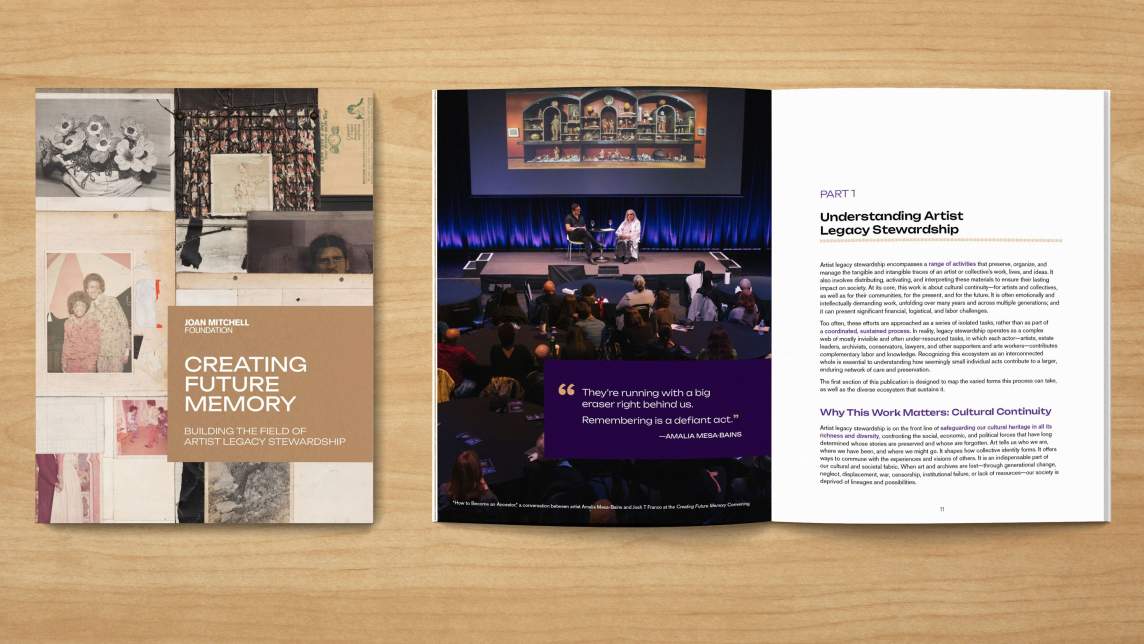
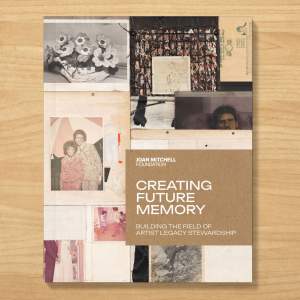
What happens to an artist’s work, archives, and ideas when they are gone? What resources and knowledge are required to steward them—and who carries that work forward? How can the arts community take greater responsibility for this work while ensuring that the stories we tell reflect the full breadth of creative production? And how can artists retain agency over how their practices are understood and remembered? These questions have guided the Joan Mitchell Foundation’s research and programming for many years, and what we have learned is reflected in the pages of a new report to the field: Creating Future Memory: Building the Field of Artist Legacy Stewardship.
This publication is both a call to action and an invitation: We aim to share the current state of artist legacy work in the United States today—its commitments, its gaps, and its possibilities— while making the case for deeper, more equitable investment across sectors and communities, within the arts and beyond. The report highlights innovative models that we have seen in the field, alongside big ideas that could strengthen the ecosystem overall for artists and arts workers.
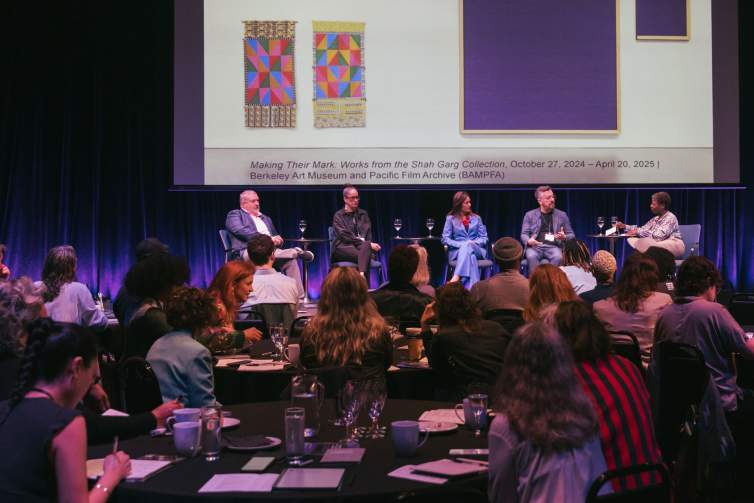
The Joan Mitchell Foundation’s commitment to artist legacy work is rooted in its experience as stewards of Mitchell’s own legacy, and builds on more than 15 years of providing resources through its Creating a Living Legacy (CALL) initiative. Drawing on this past work and ongoing research, the Creating Future Memory report is grounded in the voices and big ideas from a field-wide convening of the same name that the Foundation hosted in May 2025 at BRIC in Brooklyn, with support from the Mellon Foundation. The event brought together 145 individuals: artists, family members working on their loved ones’ legacies, legacy workers, representatives from artist-endowed foundations, archivists, conservators, curators, grantmakers, and representatives of art institutions, the market, and governmental agencies.
The Creating Future Memory convening took place at a moment of heightened concern about the political situation in the United States and abroad, and the intensifying erosion of cultural infrastructure globally. To ensure it could serve as a genuinely safe space for candid exchange, sessions and conversations were not recorded. Instead, two notetakers captured salient contributions and observations.
What we heard from participants at the convening was both inspiring and sobering: across the country, individuals, collectives, and organizations are doing extraordinary work to preserve artistic legacies—yet these efforts remain largely disconnected from one another and chronically under-resourced. Alongside this dedication, we continue to hear urgent accounts of loss: archives discarded or damaged, artworks destroyed, artists forgotten. And perhaps most persistently, we hear from artists’ family members and other legacy workers that they are overwhelmed from taking on the enormity of this work with a lack of adequate knowledge, funding, connections, or infrastructural support.
Inside the Report
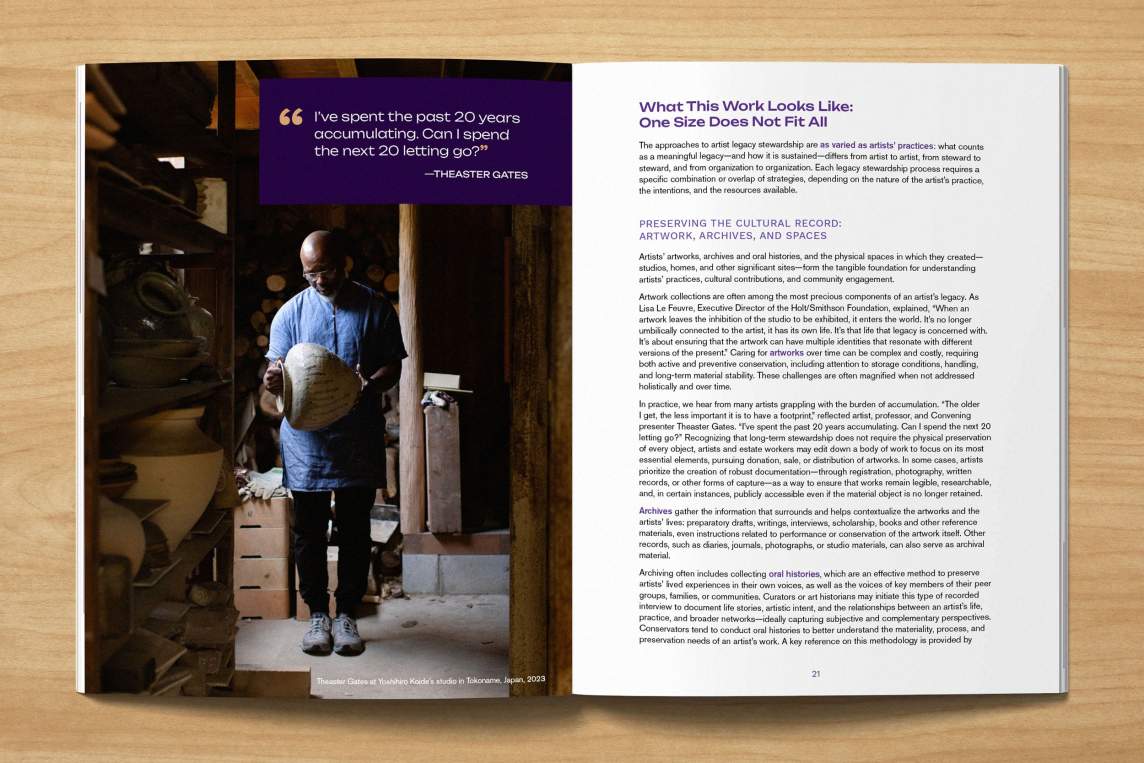
Drawing on voices from the Convening and our broader research, Creating Future Memory: Building the Field of Artist Legacy Stewardship offers some grounding on what legacy work can encompass. It maps key challenges, alongside emerging ideas, innovative approaches, and opportunities.
My husband Kikuo always said there are two deaths: the first is physical, and the second is when nobody talks about you. I decided to never give him the second death.”
Mikiko Ino, KINOSAITO
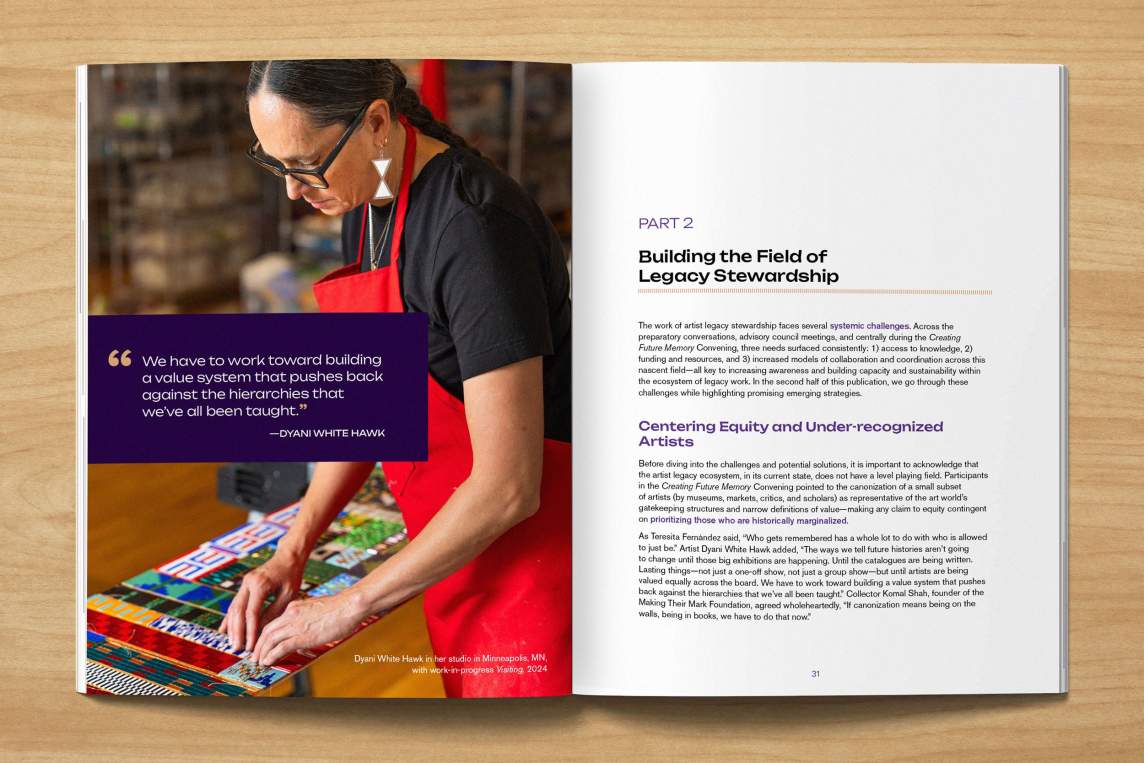
I think we need to reframe the idea of who archives are for, and perhaps invert this idea that artists need help to preserve their legacies. Instead, we should highlight that archives are for everybody.”
Teresita Fernández, artist
I’ve seen artwork taken out of studios and thrown into a dumpster and it’s very painful to witness. Every one of us is vulnerable.”
Juan Sánchez, artist
Echoing the many voices reflected throughout this publication, we at the Joan Mitchell Foundation believe that artist legacy stewardship is an essential, communal responsibility. It shapes how cultural memory is formed over time: what inspires us, what endures, and whose stories are valued, made visible, and carried forward. We operate within a field (and a society) shaped by long-standing structural inequities, where patterns of omission and uneven recognition have influenced what is preserved and shared. Engaging critically with these histories—and working to address their ongoing impact—is an integral part of this work. In the current political climate, as cultural erasure accelerates, the need for collective action has never been more pressing.
Where do we go from here?
We have been listening, learning, and recommitting to artist legacy support through this process. Moving forward, the Foundation is taking several steps towards this vision:
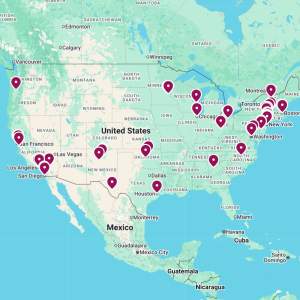
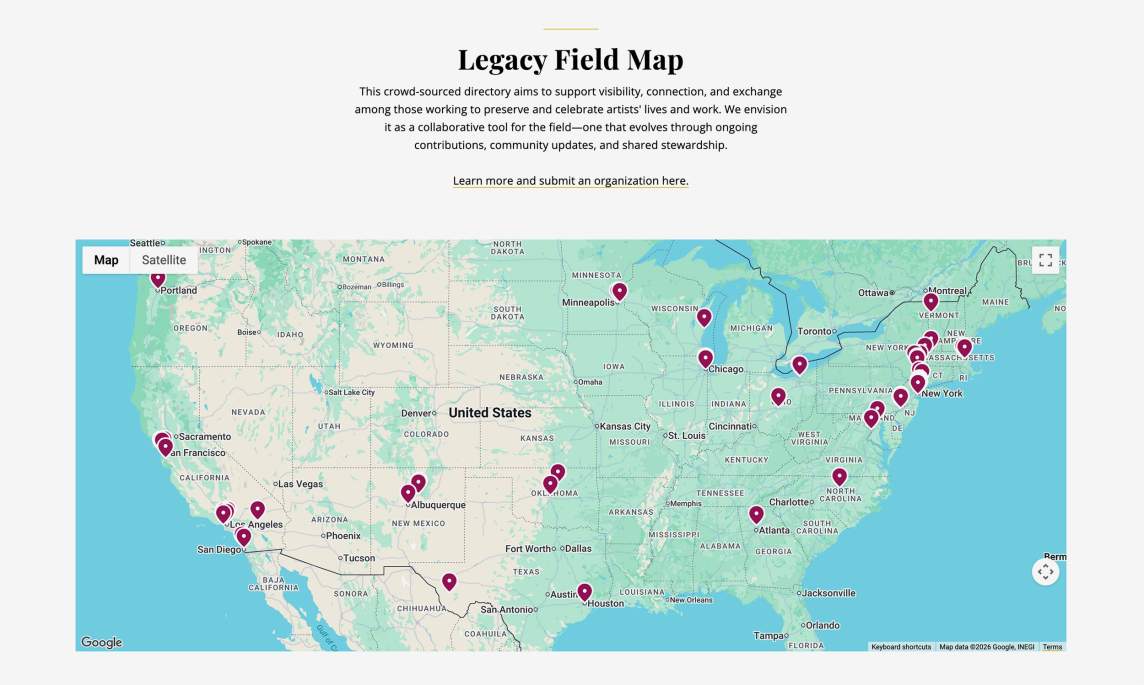
Alongside this publication, we are launching a Legacy Field Map to give visibility to nonprofit organizations doing work in this area, so that we can find each other, connect, exchange, learn, and hopefully collaborate.
We are expanding legacy-related training and curricula for artists through our fellowships and residencies, and will keep making these resources available to others publicly.
We are exploring deeper training and funding models to return to supporting artists directly in legacy work. We expect to pilot a new “CALL Intensive” program in 2029.
We are currently providing short-term space in our offices for estates and collectives to process their archives, and intend to continue incubating and providing resources for new legacy initiatives in the future.
Building the future of this field requires capacity building on all fronts.
Alongside the Foundation’s new initiatives and commitments, we’re calling for investment in widespread training, developing accessible tools, and promoting knowledge sharing so that artists, legacy workers, arts professionals, organizations, and institutions more broadly are better equipped to carry legacy work forward. It also means bringing more capital into the field—through creative funding models, pooling funds, and rethinking the ways artists and organizations earn and allocate their resources.
Building that future also requires sustainability and collaboration. As many said during our conversations, money, time, space, emotional bandwidth, and capacity are finite. Instead, we need to connect people, organizations, and resources so that legacy work is not carried out in isolation, but as part of a shared, mutually reinforcing ecosystem. This work needs the commitment (and responsibility) of an intergenerational continuum—of individuals, community-based organizations, and also, most importantly, of large institutions. This requires raising awareness, shifting cultural understanding of legacy work, and building a collective infrastructure—sustained through collaboration and thought partnership, and guided by a shared commitment to cultural continuity. No one can do this alone.
The work ahead is clear: let’s recognize its importance, resource it sustainably, and develop the capacity to carry it forward. We look forward to continuing conversations and developing collaborations to ensure we can reach the scope and scale that this work necessitates. Let’s learn from artists, and look at creative, care-centered models. Together, let’s build something that we can collectively imagine and believe in.